• Skip to main content
  • Skip to primary sidebar

Collection Agency

  • Home
  • Pricing
  • Contact Us for Collections

debt recovery

by

Effective Overdraft Fee Recovery for Banks: Collection Agency

Banks, credit unions, and fintech companies can use a specialized overdraft fee collection agency to recover charged-off checking accounts, negative balances, NSF charges, and unpaid overdraft fees. CA-USA combines account validation, respectful consumer outreach, flexible payment arrangements, nationwide collection capabilities, and performance-based pricing to help financial institutions improve recoveries while protecting customer relationships and reducing compliance risk.

Customer discussing an overdraft fee repayment plan with a collection agency representative.


Managing charged-off Demand Deposit Accounts (DDA) requires a precise balance between maximizing financial recovery and adhering to strict regulatory standards. When negative balances, Non-Sufficient Funds (NSF) charges, and overdraft fees go unpaid, financial institutions face mounting operating losses. Partnering with a specialized, CFPB-compliant collection agency allows banks, credit unions, and fintech platforms to restore lost revenue while protecting institutional reputation and consumer trust.

⭐️ Trusted Financial Recovery Partner

Backed by a 4.8-star Google rating across 1,500+ verified client reviews, nationwide licensing, SOC 2 Type II data security, easy to use, and strict CFPB compliance, CA-USA provides risk-free, diplomatic debt recovery for financial institutions across all 50 states.

Quick Answer: What is an Overdraft Collection Agency?

An overdraft collection agency is a specialized financial recovery partner that collects charged-off Demand Deposit Accounts (DDA), negative balances, and non-sufficient funds (NSF) fees for banks, credit unions, and fintech lenders. Operating strictly under CFPB, Reg E, and FDCPA compliance standards, a specialized agency recovers financial institution losses without exposing the bank to class-action litigation or brand damage.


Navigating Regulatory Compliance in DDA Collections

Collecting on negative bank balances and overdraft fees carries heightened scrutiny from federal regulators and consumer protection agencies. Generic debt collection tactics expose financial institutions to severe legal liabilities and public backlash.

To safely recover charged-off deposit accounts, your recovery program must address key regulatory frameworks:

  • CFPB Guidance & “Junk Fee” Scrutiny: The Consumer Financial Protection Bureau aggressively monitors financial institutions for improper overdraft practices, illegal transaction re-sequencing, and unvalidated fee assessments.

  • Regulation E (12 CFR Part 1005) Opt-In Verification: Collections can only proceed on overdraft accounts where the account holder provided explicit, compliant opt-in consent for automated teller machine (ATM) and one-time debit card transactions.

  • Fair Debt Collection Practices Act (FDCPA) & Regulation F: All written communications, call frequencies, and electronic notices must adhere strictly to debt collection validation and contact rules.

A specialized banking collection agency validates account documentation prior to initiating outreach—ensuring every account pursued meets federal compliance standards.

Comparing Recovery Strategies for Charged-Off Deposit Accounts

Recovery Feature In-House Bank Recovery Standard B2B Agency CA-USA Specialized DDA Recovery
CFPB & Reg E Auditing High Internal Workload Low / Generic Compliance Automated Account Validation
Data Security & Core Integration Manual Account Export Manual CSV Uploads SOC 2 Type II Encrypted & Core Integration
Licensing Scope Local / Regional Partial State Coverage Fully Licensed Nationally (50 States)
Brand Protection Maximum Control High Public Backlash Risk Diplomatic & Consumer-Safe Outreach
Recovery Rate (90+ Days) 10% – 15% Average 15% – 20% Average 30% – 45% Average

A Diplomatic Approach to Negative Balance Recovery

Bank account holders often accumulate negative balances due to sudden financial hardship, unexpected recurring fees, or administrative confusion rather than intentional fraud. Treating consumers with empathy yields significantly higher recovery rates.

Our DDA recovery workflow focuses on constructive resolution:

  1. Account Audit & Data Scrubbing: Verifying Regulation E consent records, auditing fee calculations, and cross-checking accounts against bankruptcy and military databases (SCRA).

  2. Multi-Channel Soft Communication: Reaching account holders via diplomatic written notices, SMS, and email options compliant with Regulation F digital disclosure standards.

  3. Structured Payment Arrangements: Offering flexible installment plans or fee-mitigation settlements that allow consumers to cure their negative balance without financial collapse.

  4. Credit Bureau Reporting Compliance: Reporting delinquent accounts accurately to major credit bureaus in compliance with FCRA regulations, motivating settlement while preserving consumer rights.

Why Banks and Credit Unions Partner With Us

  • Nationwide Licensing & Legal Coverage: Fully licensed, bonded, and compliant to recover debts in all 50 U.S. states.

  • SOC 2 Type II Data Security: Enterprise-grade encryption, audited portals, and strict data privacy protocols ensuring total customer confidentiality.

  • Dedicated Account Managers & Support: Award-winning customer support providing real-time reporting, transparent account status tracking, and responsive assistance.

  • Core Banking Integration: Seamless data workflows compatible with major core processing platforms (Fiserv, FIS, Jack Henry, and custom fintech APIs).

  • Performance-Based Contingency: No upfront fees—we only earn a fee when we successfully recover funds for your institution.

Need a Collection Agency: Contact us

Serving banks and credit unions nationwide


CA-USA offers Fixed-fee services for about $16 per account and Contingency fee services for 40%.
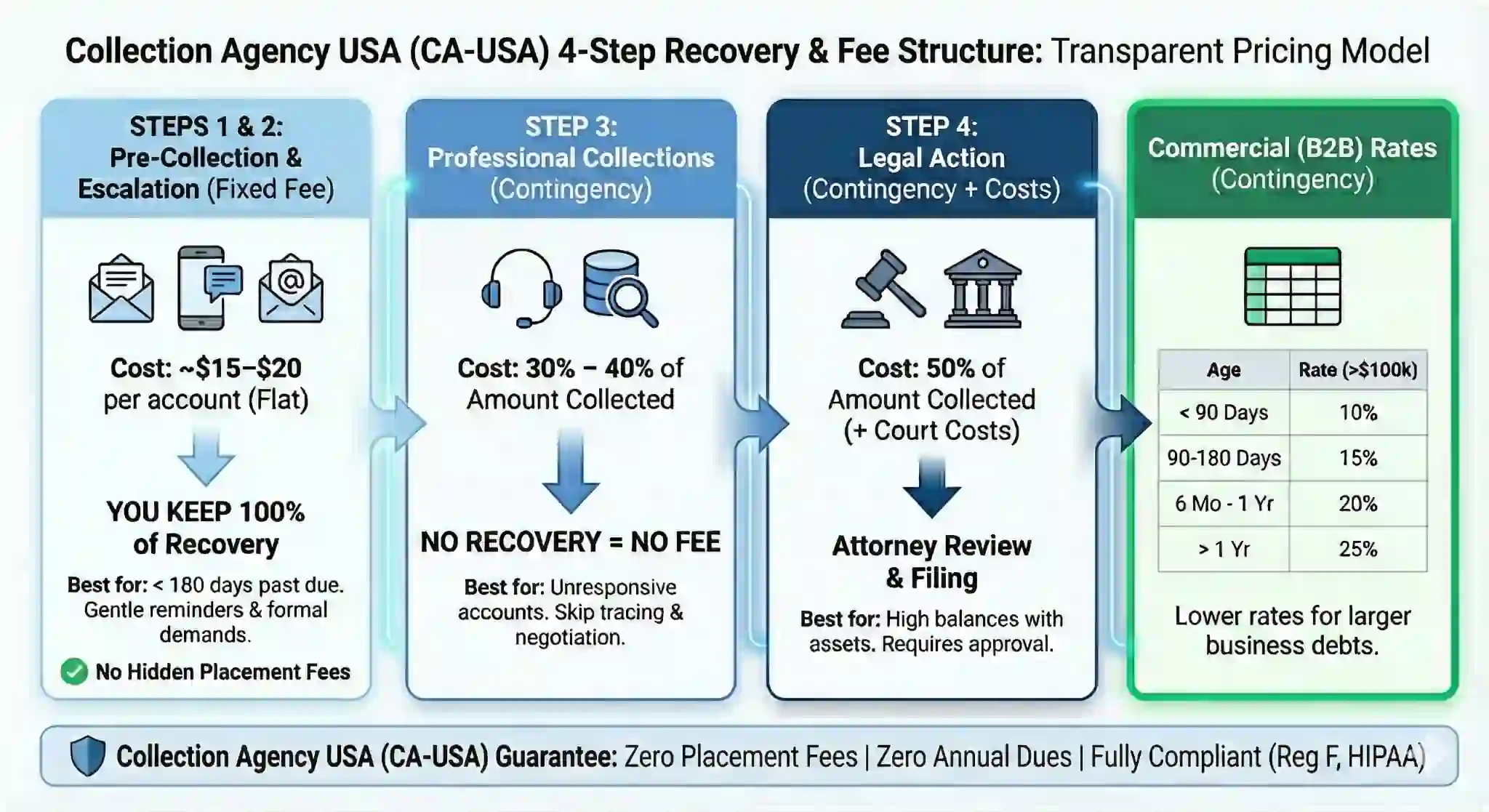
Various services of CA-USA include fixed fee services starting $16 per account, and contingency fee of 40%


Frequently Asked Questions

Is it legal for a collection agency to collect on bank overdraft fees?

Yes. Collection agencies can legally recover charged-off overdraft balances provided the original financial institution complied with Regulation E opt-in requirements and CFPB disclosure rules.

How do collection agencies recover negative bank account balances?

Specialized agencies use advanced skip-tracing, soft written notices, structured repayment plans, and credit bureau reporting to recover charged-off DDA balances ethically.

Why should banks outsource charged-off overdraft accounts to an agency?

Outsourcing frees internal banking operations, ensures compliance with strict CFPB debt collection rules, and significantly boosts recovery rates on aged 90+ day negative balances.

What happens if an account holder disputes an overdraft fee?

When a dispute occurs, the agency halts collection activity immediately and requests original account statements, Reg E disclosures, and deposit agreements from the financial institution to validate the debt.
Filed Under: debt recovery

by

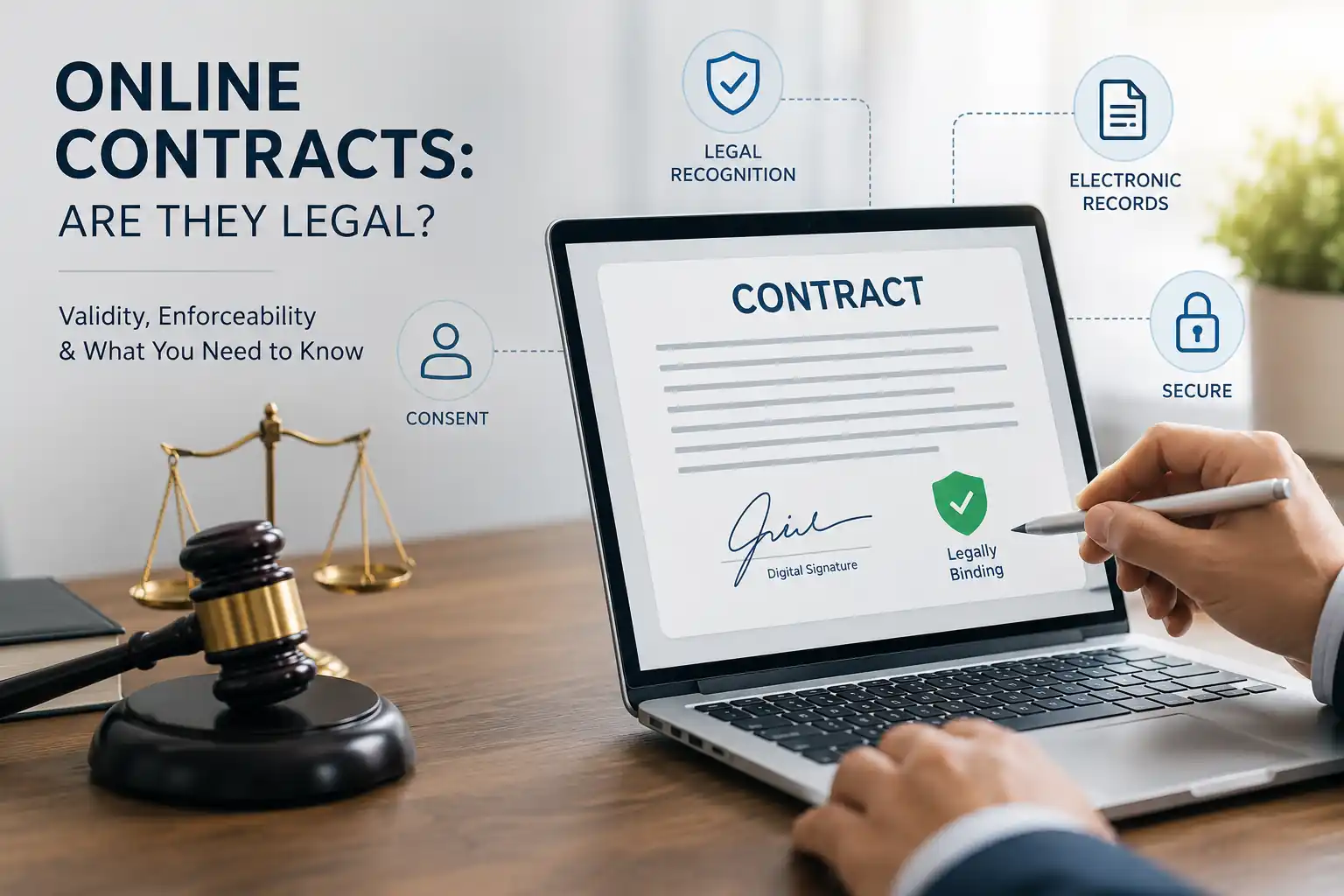
Are Your Online Contracts Legally Enforceable in Debt Collections?

You chase an unpaid invoice for weeks, finally get the client on the phone, and hear the words that stop debt recovery cold: “I never signed that,” or “I don’t even remember agreeing to those terms.” Whether that excuse actually holds up depends entirely on how the agreement was created in the first place, and most businesses only find out the hard way that not every online contract is built to survive that question.

Quick answer: Yes, online contracts are generally enforceable for debt collection, provided they meet the same legal standard as any contract: clear terms and demonstrable assent. Clickwrap agreements (an affirmative “I Agree” click) are consistently upheld in court; browsewrap agreements (terms merely linked in a footer) are frequently ruled unenforceable because assent can’t be proven.

Can you collect on an unpaid online agreement? Learn how clickwrap terms, E-SIGN compliance, and audit trails impact legal debt recovery.

Need to collect on an unpaid account? 

Contact us for a recovery process built around what’s actually provable.


E-SIGN Act & UETA: The Baseline for Digital Collections

Under the federal E-SIGN Act (2000) and the state-level Uniform Electronic Transactions Act (UETA, adopted in nearly every state), an electronic signature or digital record carries the same legal weight as an ink signature or paper contract, provided the basics are met: the signer consented to do business electronically, intended to sign, and the record is retained in a form that can be accurately reproduced later. Neither law cares how the signature was captured; a checkbox click counts exactly as much as a handwritten signature, as long as the underlying process can prove genuine assent. That’s the part where most businesses’ contracts actually fall apart in a collections dispute, not the legal validity of “online” agreements as a category.

Contract Type vs. Collection Enforceability

Contract Type Enforceability Rating (1–10) Required Proof for Collections Common Pitfall in Recovery
Clickwrap (checking “I Agree”) 9 Timestamp, IP address, account ID, and the specific terms version shown at the moment of acceptance Failing to log which version of the terms was shown, so an updated agreement gets confused with the one actually accepted
E-Signatures (DocuSign/HelloSign) 9 The signed document plus the platform’s own certificate of completion (audit trail, IP, timestamp, authentication method) Keeping only the signed PDF and discarding the underlying certificate the platform generates separately
Sign-in-Wrap (terms linked near login/signup) 5 A screenshot of the exact signup flow, plus proof the link was reasonably conspicuous Assuming this counts as clickwrap; courts treat it as a genuine middle ground, and a debtor can credibly claim they never saw the terms
Browsewrap (footer links only) 2 Actual, provable notice through some other channel (a prior email referencing the terms), since the footer link alone rarely counts Relying on a footer link as if it were a signed contract, the single most common reason a “signed” debt turns out to be uncollectable

The 4-Part Audit Trail Required to Win a Collection Dispute

  1. IP Address at the Moment of Acceptance — ties the specific action to a specific device and location.
  2. Timestamp — proves exactly when assent happened, ideally cross-referenced against the invoice or service date.
  3. A Record of the Exact Terms Version Shown — not just today’s terms page, but the specific version active at the moment of acceptance, since terms change over time.
  4. User/Account Identification — the specific login, email, or account ID tied to that acceptance, connecting the click to an identifiable person or business.

A fifth layer worth adding where practical: tele-verification. A brief call confirming the client’s identity, contact details, and understanding of the payment terms, recorded with their consent, adds a verbal confirmation on top of the digital record. It’s not required the way the four elements above are, but it’s a genuinely strong addition when the account size justifies the extra step.

Why “Browsewrap” Fails in Debt Recovery (And How to Fix It)

Burying terms of service in a website footer, with no requirement that anyone click, check, or acknowledge them, creates exactly the outcome debt collection depends on avoiding: no provable record the other party ever saw or agreed to anything. This isn’t a theoretical risk. One widely cited figure puts clickwrap’s 2020 court success rate at roughly 70%, against 14% for browsewrap, and a 2022 Ninth Circuit decision, Berman v. Freedom Financial Network, held that website terms must be “reasonably conspicuous” and the user must show “manifest unambiguous assent,” or the terms are void. Courts have consistently found browsewrap enforceable only when a business can show the debtor had actual notice some other way, a prior email referencing the terms, a printed acknowledgment, something beyond “the link was technically there.”

The fix costs almost nothing: require an affirmative checkbox or button click before an order, signup, or service begins, and log the interaction. That single change is the difference between a collection agency having something to work with and a debt that’s legally difficult to prove ever existed as agreed.

Essential Collection Clauses to Include in Your Online Terms

  • Attorney/Collection Fee Recovery Clause — states explicitly that the debtor is responsible for reasonable collection costs and attorney’s fees if the account goes to collections. Without this clause written in beforehand, recovering those costs separately can be difficult or impossible depending on the state.
  • Interest Rate on Overdue Balances — a specific, stated rate (subject to state usury limits) removes ambiguity about what’s actually owed as an account ages.
  • Forum Selection Clause — specifies which state’s law and which court has jurisdiction over a dispute, avoiding a fight about where a collections case even gets filed.

Frequently Asked Questions

What proof do I need to submit an online agreement to a collection agency?

A collection agency needs the accepted terms, a timestamp, an IP address, and the account identity tied to that specific acceptance, not just a copy of your current terms of service page. The version of the agreement actually active and shown at the moment of acceptance matters more than what your website says today, since terms change over time and a mismatch between the two can undercut an otherwise solid claim.

Can a debtor dispute a bill if they signed via an e-signature app like DocuSign?

Rarely successfully, since platforms like DocuSign generate their own certificate of completion documenting the signer’s identity, IP address, and timestamp. A debtor disputing a DocuSign-signed agreement is arguing against a purpose-built audit trail, not just a business’s word, a much harder position than disputing a bare browsewrap footer link. The business still needs to actually retain that certificate, not just the signed PDF, once the account goes to collections.

Why do “Browsewrap” agreements frequently fail in debt collection disputes?

Browsewrap fails because it requires no affirmative action, so there’s no reliable record the debtor ever saw or agreed to anything. Courts have consistently ruled that a footer link alone doesn’t establish the “manifest, unambiguous assent” contract law requires, and one federal appeals court decision held that without reasonably conspicuous notice and a clear affirmative act, browsewrap terms are void. Without that proof, a collection agency is left arguing over a contract that may not legally exist.

Can I collect collection fees or interest on an unpaid online agreement?

Only if your original terms explicitly said so, since courts generally won’t add fees or interest that weren’t part of what the debtor actually agreed to. A collection-fee recovery clause and a stated interest rate on overdue balances, written into the terms before the debt was ever incurred, are what make those additional charges collectable later. Adding either one after the fact, once an account is already past due, generally doesn’t hold up.

Filed Under: debt recovery

by

FERPA-Compliant Debt Recovery for Schools, Colleges & Universities

Between evolving state laws and federal restrictions on traditional leverage, alongside rising K–12 meal debt and university tuition balances, outdated collection tactics create severe regulatory and PR risks for educational institutions.

Safely recovering unpaid tuition, meal balances, registration fees, and campus charges requires a diplomatic, privacy-first approach that protects your institution’s reputation while preserving sensitive parent, student, and alumni relationships.

School administrator reviewing tuition payment records and student fee collection accounts in a school finance office.

A K-12 district and a university are both “schools” in casual conversation, but they face almost entirely different regulatory exposure when a balance goes unpaid. A public school district’s real risk is around meal debt: USDA policy requirements and a fast-growing list of state anti-“lunch shaming” laws. A college’s real risk is the transcript-withholding restrictions that took effect in July 2024. Treating both under one generic “school collections” playbook, the mistake most agencies (and most advice online) make, means missing the rules that actually govern whichever one you actually are. CA-USA (Collection Agency USA) builds the recovery strategy around the institution type first, not a one-size-fits-all script.

Quick answer: FERPA-compliant debt recovery differs by institution type: K-12 districts face USDA meal-debt rules and state anti-lunch-shaming laws, while colleges and universities face federal Title IV and state transcript-withholding restrictions effective since July 2024. Both require verifying authorized parties before disclosing any student financial record and avoiding tactics that single out the student rather than the responsible adult.


Ethical & Compliant Recovery for Private Schools, Colleges & Districts.

Contact us  to recover student tuitions, meals and other fee !

Backed by 4.8-star Google ratings across 2000+ reviews, our platform combines bank-grade data security, effortless ease of use, and dedicated customer support.


Two Institutions, Two Different Rulebooks

K-12 Schools and Districts

The dominant issue here is meal debt, not transcripts. Every School Food Authority must maintain a written meal-charge policy under USDA rules, and more than a dozen states have banned “lunch-shaming” tactics outright: publicly identifying a student with debt, serving a different meal, or discarding a tray in front of classmates. Some states go further. California prohibits the use of a collection agency for student meal debt entirely, and Virginia bars school boards from suing a family over it. For private K-12 schools that charge tuition, a report card or diploma withheld over an unpaid balance is governed by ordinary contract law, not the college transcript-ban statutes below; the two get confused often, and shouldn’t be.

Colleges and Universities

Effective July 1, 2024, U.S. Department of Education rules significantly restrict withholding transcripts for any term covered by Title IV federal aid, the financial aid program that funds post-secondary education specifically. Beyond the federal layer, a dozen or so states, including New York, California, Colorado, Illinois, and Washington, ban transcript withholding as a collection tactic outright, regardless of aid status. An institution still relying on transcript holds as its main leverage is depending on a tool that’s disappeared, or is disappearing, jurisdiction by jurisdiction.

The 3 Hidden Legal & PR Risks of Generic Collection Agencies

Invalid Leverage (Colleges). An agency relying on transcript withholding as its primary threat for a college account is, in a growing number of states, threatening something it can no longer legally deliver.

The Front-Desk Nightmare (Both). When a generic agency’s tactics upset a parent or student, that complaint doesn’t go to the agency, it goes to the Bursar, the Principal, or a School Board member, turning a routine receivable into a governance headache.

FERPA Exposure (Both). Tuition and fee records are protected education records, not ordinary consumer debt. A collector who contacts a grandparent, stepparent, or employer to discuss a balance without verifying they’re an authorized party may be creating a federal privacy violation the institution is ultimately accountable for.

Standard Agencies vs. FERPA-Compliant Specialists

Factor Standard Collection Agency FERPA-Compliant Specialist
K-12 meal debt May apply the same tactics used for adult consumer debt Follows USDA meal-charge policy and state anti-shaming rules specifically
College tuition debt May still rely on transcript withholding as primary leverage Credit reporting, skip-tracing, and negotiated plans, since transcript holds are restricted or banned in a growing number of states
FERPA awareness Treats a balance like ordinary consumer debt Verifies authorized parties before any disclosure, for both parents and college-age dependents
Escalation point Complaints land on the Bursar’s or Principal’s desk Diplomatic first contact designed to avoid escalation
Enrollment impact Balance recovery only Recovery structured to preserve re-enrollment where realistic (especially relevant for colleges)

10 Core Expectations Institutions Demand From a Recovery Partner

  1. Compliance with Laws and Regulations — Strict adherence to the FDCPA, Regulation F’s call-frequency limits, and applicable education-sector and state-specific codes, whether K-12 or higher ed.
  2. Ethical Practices — Respectful, professional communication with families; no aggressive or harassing tactics, and no tactics that single out a student specifically.
  3. Transparency — Real-time reporting on accounts receivable so the Board or bursar’s office knows exactly where the budget stands.
  4. Efficiency and Effectiveness — Proven recovery strategies for tuition, technology fees, and meal debt that don’t drag on for months.
  5. Confidentiality and Security — FERPA, GLBA, and, where relevant, HIPAA-level protection of student and family financial data.
  6. Customized Services — Communication methods and timing tailored to whether the institution is a K-12 district or a college.
  7. Customer Service — Responsive to both the institution and the families being contacted, resolving disputes fairly.
  8. Minimal Disruption — The process runs largely independently, requiring minimal staff involvement.
  9. Affordable and Reasonable Fees — Costs that stay proportionate to what’s actually recovered.
  10. Positive Representation — Every interaction reflects on the institution, so the agency represents an educational institution, not a credit card company.

Cost Effective Collections

Choose between low cost fixed fee collections, or standard contingency collections.

Various services of CA-USA include fixed fee services starting $16 per account, and contingency fee of 40%

Frequently Asked Questions

Does the federal transcript-withholding ban apply to K-12 private schools, or just colleges and universities?

It’s specifically a higher-education rule, tied to federal Title IV financial aid, which only funds post-secondary education. K-12 schools, public or private, don’t participate in Title IV and aren’t covered by this regulation. A private K-12 school withholding a report card or diploma over unpaid tuition is instead governed by ordinary contract law and whatever narrower state-specific rules exist, not the college transcript-ban framework. The two situations get confused constantly, and treating a K-12 tuition dispute as though the college-specific federal rule applies is a real, avoidable mistake.

How do you manage “Joint and Several Liability” when divorced parents dispute tuition bills?

The enrollment contract’s signatures decide liability, not a private custody arrangement between the parents. If both parents signed, the debt is generally treated as joint and several, meaning either party can be pursued for the full balance regardless of what a divorce decree says. Family court disputes between the parents are a separate matter from the institution’s contractual right to be paid.

How do new federal regulations impact transcript withholding for unpaid college balances?

As of July 1, 2024, transcript withholding for any term covered by Title IV federal aid is significantly restricted under U.S. Department of Education rules. Beyond the federal layer, several states, including New York, California, Colorado, Illinois, and Washington, have banned the practice outright regardless of aid status. This applies to colleges and universities specifically, not K-12 institutions.

Is collecting small “lunch debt” balances worth the public relations risk for a district?

Yes, when it’s done through low-cost, automated, non-punitive outreach rather than tactics that single out a child. The median district carries roughly $6,900 in unpaid meal debt, real money against a real budget, and polite digital reminders sent to a parent carry essentially none of the PR risk that hand-stamping or serving a different meal does.

How do you guarantee FERPA compliance during debt recovery outreach?

Compliance starts with verifying who’s actually authorized to discuss a specific student’s financial record before any conversation happens, not after a complaint. Tuition and fee balances are protected education records, so a call to an unverified party is a potential federal violation. Strict identity verification and data silos that prevent unauthorized disclosure are the baseline, not an add-on feature.

What is the difference between fixed-fee tuition demands and contingency collections for schools and colleges?

Fixed-fee demands are a flat, predictable cost for early-stage balances, generally the better fit for accounts still within the same or following term. Contingency collections carry no upfront cost but take a percentage of whatever’s recovered, better suited to older, charged-off, or unresponsive accounts. Most institutions use fixed-fee first and reserve contingency for what fixed-fee doesn’t resolve.

Contact us for a free consultation !

By CA-USA Editorial Team | Updated 2026

Filed Under: debt recovery

by

Collection Agency for Small Businesses: Cost-effective Recovery

A collection agency for small businesses helps recover overdue invoices while reducing the time owners spend chasing payments. Businesses can choose fixed-fee written demands costing $10–$27 per account or contingency collections with no upfront fee.

Do the math on your last unpaid invoice. Not the invoice amount, the hours: the follow-up emails, the “just checking in” calls, the mental tax of wondering if this is the one that finally pays. Add it up at whatever you actually bill per hour, and most small business owners are shocked at what “handling it myself” has actually been costing them. This isn’t a pitch for a big collections operation. It’s a fixed-fee option built for exactly the invoice you’re thinking about right now.

Business professional reviewing debt recovery results and recovered invoices in a modern office.

Three Myths Keeping Small Business Owners From Ever Making the Call

Myth: “It’ll cost more than the invoice is worth.”

Reality: A $10–$27 flat fee against even a modest invoice is rarely a bad trade, especially against the real cost of your own time. Bill yourself even $50 an hour for the calls and emails you’d otherwise be sending, and three hours of DIY follow-up already costs more than most fixed-fee accounts.

Myth: “A collection agency will be aggressive and I’ll lose the customer for good.”

Reality: The first move isn’t a threatening phone call, it’s five written demands sent under professional letterhead, enough on its own to resolve the account over 40% of the time. A customer who eventually pays in full often keeps buying from you afterward. A 4.85-star rating from 1,500+ business owners who’ve actually gone through this process is the real answer to whether “sent to collections” has to mean “relationship over”: for most of them, it didn’t.

Myth: “I only have one small unpaid invoice, it’s not worth the hassle of a whole ‘agency.'”

Reality: There’s no minimum, no annual commitment, and no reason a $400 invoice gets treated differently than a $40,000 one. The paperwork is the same either way. Waiting to “save up” a batch of bad debt before doing anything just gives the oldest accounts more time to become genuinely uncollectible.

The Real Math

Path What Actually Happens
Do nothing ~$0 recovered; the invoice quietly gets written off
Chase it yourself Real hours spent, no guarantee of payment, and the “am I being too pushy” anxiety the whole time
Fixed-Fee (Option A) $10–$27 flat per account, you keep 100% of whatever’s recovered, no calls required from you
Contingency (Option B) $0 upfront, 40% of whatever’s recovered, built for accounts 120 days to 3 years old

How It Actually Works

Various services of CA-USA include fixed fee services starting $16 per account, and contingency fee of 40%

Option A: Fixed-Fee Collections – Written Legal Demands
Purchase a batch of accounts in advance and keep 100% of everything recovered. Five attorney-approved written demands go out under our name (one account = five contacts). Most effective for bills less than a year past due, and unused accounts never expire. Most clients can typically write this off as a business expense on their taxes after checking with their accountant. See why fixed-fee demands work for the fuller logic.

Option B: Contingency Collections – Collection Calls
No upfront fees. A professional debt collector makes multiple calls to your debtor, and we only earn if we collect, keeping 40% while you keep 60%. Built for accounts aged 120 days to 3 years, regardless of balance. Can be forwarded for legal collections with your approval.

Still deciding whether it’s even time to hand an account over at all? When to outsource debt collection covers that decision on its own.

What Happens After You Place an Account

The account gets verified first, then the five written demands go out under our name over the following weeks, giving the debtor several real chances to resolve it before anything more serious happens. If it doesn’t resolve, it either sits (Option A has no expiration) or moves to contingency calling (Option B), and if that stalls too, it can be forwarded to legal collections with your sign-off. Understanding debtor psychology explains why a professional third party often gets a response an owner’s own calls never did, and managing client relationships during debt recovery is worth reading if keeping the customer afterward matters to you, which for most small businesses, it does.

If your original agreement with this client was an online contract, it’s also worth confirming it’s actually legally binding before relying on it during collections.

We offer free credit reporting, free bankruptcy screening, and free skip tracing on every account, no joining fee, no minimums, no annual commitment. We also red-flag debtors with a history of suing businesses like yours. Everything runs through a secure online client portal.

Frequently Asked Questions

How do you identify “serial litigators” who sue small businesses when sent to collections?

Before initiating recovery, we run automated litigious debtor screening. If a debtor has a history of filing predatory lawsuits or TCPA/FDCPA counter-claims against small businesses, they’re red-flagged immediately. This protects your business from accidental legal liability before a single letter or call goes out.

Can fixed-fee collection costs actually be written off on my business taxes?

Yes, in most cases. Because our Option A fixed-fee service is purchased upfront as a professional debt collection expense, business owners can generally deduct the $10–$27 per account fee as a standard business operating expense. We always recommend confirming specific deductions with your CPA.

What happens if a non-paying client suddenly becomes a profitable repeat customer again?

Maintaining client relationships is critical for small business sustainability. By using our Fixed-Fee Written Demands (Option A) first, the outreach comes across as a firm administrative audit rather than an aggressive third-party demand. If the client pays 100% of the balance, you keep 100% of the money, allowing you to reset terms and preserve the long-term business relationship without burn-bridges tactics.

What if a debtor moves out of state or disappears entirely without leaving a forwarding address?

We perform free skip tracing on all accounts submitted. Using public records, utility listings, credit header databases, and proprietary lookup tools, we locate the debtor’s updated contact info and address at no extra charge to your business.

Why should a business choose $10–$27 fixed-fee demands over traditional contingency collections?

For debts less than 1 year past due, a formal third-party legal demand letter resolves the issue over 40% of the time. Choosing Option A (Fixed-Fee) lets you keep 100% of the recovered funds for a flat fee, whereas contingency collections (Option B) require giving up 40% of the recovered balance. Starting with fixed-fee demands saves thousands in commission fees.

Filed Under: debt recovery

by

Recover Unpaid Patient Balances Without Burning Bridges or Violating HIPAA

Writing off unpaid patient bills shouldn’t be the default price of running a healthcare practice. Collection Agency USA (CA-USA) is a top-rated, HIPAA-compliant medical collection agency serving hospitals, dental practices, and physicians nationwide with zero account minimums. By offering a flexible 4-step recovery system—starting at a $16 flat-fee reminder service where practices keep 100% of collections—CA-USA delivers brand-safe patient outreach, full FDCPA and GLBA compliance, and credit bureau reporting without forcing practices to sacrifice patient goodwill or pay upfront attorney fees.

A doctor evaluating unpaid medical bills, considering to hire a medical collection agency

We serve over two thousand of healthcare providers across the nation, including hospitals, urgent care centers, dental offices, senior living communities, physicians and ambulance services in all 50 states. Our focus is on achieving outstanding recovery rates.

Our priority is to protect your reputation while we collect payments from patients. We ensure that your patients are treated with respect and dignity, applying only the minimal amount of pressure legally allowed during the collection process. Both clients and patients consistently find our services user-friendly and easy to navigate.

Need a Medical Collection Agency: Contact Us

Our debt recovery methods are strategically designed to expedite debt retrieval while maintaining cost-effectiveness.

We take pride in being the highest-rated Medical Collection Agency on Google, with an impressive rating of 4.87 out of 5 from over 2,200 reviews. We’ve also established a user-friendly client portal, enabling you to add debtors at your convenience.

Start Recovering:

    Please prove you are human by selecting the cup.

    Four-Step Debt Recovery Process:

    Medical collection agency services and fees

    STEP 1: Flat Fee Reminders – First Party
    If your practice lacks time for patient reminders, we can help. We make two calls and send three letters on your behalf, not as a collection agency, for a flat fee of $16 per case. Your practice keeps 100% of what is collected.

    STEP 2: Flat Fee Collections – Third Party
    Demands are sent on the collection agency’s own letterhead for a flat fee of $16 per case, making patients more likely to pay. Your practice keeps 100% of collections, and payments are made directly to your office. Five letters are sent, one every 10 days.

    STEP 3: Intensive Collections – You Keep 60% of Amount Collected – No Upfront Cost
    For the small minority who do not pay in Step 2, we transfer these accounts to our intensive collection group. Our friendly agents call persistently with the goal of working with your client to pay the debt owed. In this stage, you keep 60% of the amount collected.

    STEP 4: Legal/Litigation – 50/50 Split and No Attorney Fees
    We conduct a full financial assessment of each debtor. If legal action is needed, we request your authorization to proceed. If approved, we file the lawsuit and pay your practice 50% of the awarded amount.

    Get Started with $16 Flat-Fee Medical Collections


    Unique features of our Medical Collection Agency

    1. Low-Cost Fixed-Fee Service: Your unused accounts remain active without expiring.
    2. Standard Contingency Service: We operate on a “no recovery, no fee” basis.
    3. Legal Collections: Utilizing a national network of attorneys, we efficiently handle legal suits for recovering your dues.
    4. Compliance: Our services strictly adhere to State and Federal laws, including HIPAA, GLBA and FDCPA.
    5. Additional Free Services: This includes Credit Bureau Reporting, Bankruptcy Screening, and a Litigious Debtor Check to identify individuals with a history of suing businesses or medical practices like yours.
    6. Nationwide Licensing: We are licensed across all 50 states and Puerto Rico, ensuring seamless handling of cases even if your patient relocates.
    7. Bilingual Collections: We offer collection services in both English and Spanish.
    8. Free Skip Tracing: We provide this service at no extra cost to locate patients who have moved, are hiding, or are otherwise unreachable.
    9. Top-Notch Accreditation: Our BBB Rating stands at an A+.
    10. Data Security: We consistently meet SSAE 18 SOC 1 Type 2 data security standards, ensuring your data is always protected.
    11. Transparent Pricing: We guarantee no hidden fees, no setup fees, and provide an easy-to-use secure client portal.
    12. Personalized Support: Each client is assigned a dedicated account manager/sales representative, along with a central toll-free support number.
    13. Flexible Usage: We impose no minimums and offer services on an as-needed basis.
    14. Athena-health Interface: This is available at no additional cost.
    15. Bulk Account Submission: Accounts can be submitted one by one or even in bulk using an Excel spreadsheet.
    16. Online Management: You can access recovery reports, submit payments, and view monthly statements online without needing to call us.
    17. Proven Track Record: We serve thousands of dental and medical practices, and references are readily available upon request.

    Frequently Asked Question

    1. Will hiring CA-USA damage my company’s brand or public reputation?

    No. We operate as an extension of your accounts receivable department, using brand-preservation techniques. Our agents are trained in dispute mediation and compliance. We recover your money without burning bridges or compromising your company’s public standing.

    2. Beyond the collection agency’s fee, can we also deduct the portion of the debt we never recover as a business loss?

    Often, yes, for businesses on the accrual method. This is generally treated as a bad debt deduction once an account is genuinely determined to be uncollectible, separate from whatever fee was paid to attempt recovery. That’s a real conversation to have with your accountant rather than an assumption to make on your own, since timing and documentation requirements matter, but it’s worth knowing an unrecovered balance isn’t necessarily a total loss with no tax benefit at all.

    3. We only have one or two small unpaid invoices. Is it even worth using a collection agency for such a small volume?

    Yes, and this is actually one of the more common ways small businesses end up working with us. There’s no minimum number of accounts and no obligation to submit any set volume annually, so a single $800 invoice gets the same professional process as a company placing fifty accounts at once. Waiting to “save up” a batch of unpaid invoices before doing anything usually just means the oldest ones get harder to collect while you wait.

    4. Why shouldn’t we just file a Small Claims Court lawsuit ourselves?

    Winning a judgment in court is only 10% of the battle; collecting the money is the other 90%. Courts do not collect the funds for you. CA-USA handles both the negotiation and the post-judgment asset recovery, saving you hundreds of hours in legal fees and administrative headaches.

    5. What if the debtor claims they aren’t paying because of a “quality of service” dispute?

    Debtors often weaponize “disputes” to freeze collection efforts. We conduct an objective audit of your signed contracts, deliverables, and communication logs to separate genuine service issues from tactical stalling, keeping the conversation focused on financial resolution.

    Filed Under: debt recovery

    • « Go to Previous Page
    • Page 1
    • Interim pages omitted …
    • Page 4
    • Page 5
    • Page 6

    Primary Sidebar

    blank

    Unpaid Bills? Contact Us

      Please prove you are human by selecting the plane.


      Email : support@CollectionAgencyUsa.com
      Ph: 1-844-666-7890

      Recent Posts

      • New Jersey Dental Collections: Clinical, HIPAA Compliant & Community-Focused
      • The 80/20 Rule in Dentistry: Executive Practice Management & AR Recovery Playbook
      • Tennessee Dental Collections: Clinical, Compliant, and Community-Focused
      • Ohio Dental Collections: Clinical, Compliant, and Community-Focused
      • Florida Dental Collections That Stay Clinical – Not Combative
      • Texas Dental Balances Don’t Age Gracefully, Recover Them Clinically
      • Close More Deals: Sales Enablement for Collection Agencies
      • 10-Step Checklist for California Dentists Before Hiring a Collection Agency
      • Trusted New York Debt Collection Services: Fully Compliant Nationwide
      • Pennsylvania Debt Collection: Simple Rules & Action Plan

      Featured Posts

      • Texas Dental Balances Don’t Age Gracefully, Recover Them Clinically
      • Trusted New York Debt Collection Services: Fully Compliant Nationwide
      • Are Your Online Contracts Legally Enforceable in Debt Collections?
      • Collection Agency for Small Businesses: Cost-effective Recovery

      COPYRIGHT: SACHING.COM | 2026 | This content is provided for general informational purposes only and should not be considered legal advice. Collection laws and requirements may vary by state, account type, documentation, debtor status, and specific facts. Please consult qualified legal counsel for guidance regarding your particular situation. CA-USA and its authorized collection partners service accounts in accordance with applicable federal and state collection requirements. Visit our home page to know more about us.