You chase an unpaid invoice for weeks, finally get the client on the phone, and hear the words that stop debt recovery cold: “I never signed that,” or “I don’t even remember agreeing to those terms.” Whether that excuse actually holds up depends entirely on how the agreement was created in the first place, and most businesses only find out the hard way that not every online contract is built to survive that question.
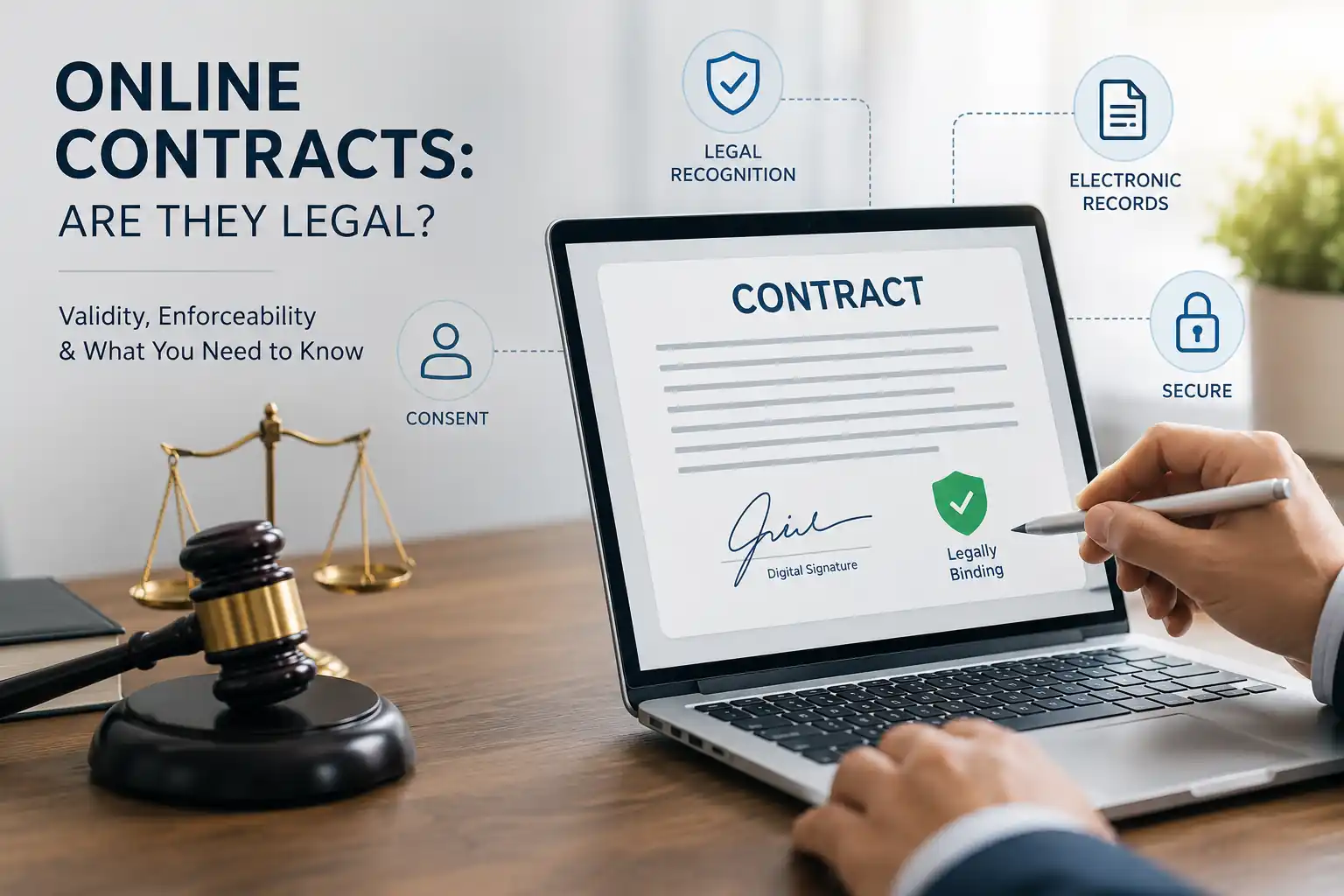
Quick answer: Yes, online contracts are generally enforceable for debt collection, provided they meet the same legal standard as any contract: clear terms and demonstrable assent. Clickwrap agreements (an affirmative “I Agree” click) are consistently upheld in court; browsewrap agreements (terms merely linked in a footer) are frequently ruled unenforceable because assent can’t be proven.
Need to collect on an unpaid account?
Contact us for a recovery process built around what’s actually provable.
E-SIGN Act & UETA: The Baseline for Digital Collections
Under the federal E-SIGN Act (2000) and the state-level Uniform Electronic Transactions Act (UETA, adopted in nearly every state), an electronic signature or digital record carries the same legal weight as an ink signature or paper contract, provided the basics are met: the signer consented to do business electronically, intended to sign, and the record is retained in a form that can be accurately reproduced later. Neither law cares how the signature was captured; a checkbox click counts exactly as much as a handwritten signature, as long as the underlying process can prove genuine assent. That’s the part where most businesses’ contracts actually fall apart in a collections dispute, not the legal validity of “online” agreements as a category.
Contract Type vs. Collection Enforceability
| Contract Type | Enforceability Rating (1–10) | Required Proof for Collections | Common Pitfall in Recovery |
|---|---|---|---|
| Clickwrap (checking “I Agree”) | 9 | Timestamp, IP address, account ID, and the specific terms version shown at the moment of acceptance | Failing to log which version of the terms was shown, so an updated agreement gets confused with the one actually accepted |
| E-Signatures (DocuSign/HelloSign) | 9 | The signed document plus the platform’s own certificate of completion (audit trail, IP, timestamp, authentication method) | Keeping only the signed PDF and discarding the underlying certificate the platform generates separately |
| Sign-in-Wrap (terms linked near login/signup) | 5 | A screenshot of the exact signup flow, plus proof the link was reasonably conspicuous | Assuming this counts as clickwrap; courts treat it as a genuine middle ground, and a debtor can credibly claim they never saw the terms |
| Browsewrap (footer links only) | 2 | Actual, provable notice through some other channel (a prior email referencing the terms), since the footer link alone rarely counts | Relying on a footer link as if it were a signed contract, the single most common reason a “signed” debt turns out to be uncollectable |
The 4-Part Audit Trail Required to Win a Collection Dispute
- IP Address at the Moment of Acceptance — ties the specific action to a specific device and location.
- Timestamp — proves exactly when assent happened, ideally cross-referenced against the invoice or service date.
- A Record of the Exact Terms Version Shown — not just today’s terms page, but the specific version active at the moment of acceptance, since terms change over time.
- User/Account Identification — the specific login, email, or account ID tied to that acceptance, connecting the click to an identifiable person or business.
A fifth layer worth adding where practical: tele-verification. A brief call confirming the client’s identity, contact details, and understanding of the payment terms, recorded with their consent, adds a verbal confirmation on top of the digital record. It’s not required the way the four elements above are, but it’s a genuinely strong addition when the account size justifies the extra step.
Why “Browsewrap” Fails in Debt Recovery (And How to Fix It)
Burying terms of service in a website footer, with no requirement that anyone click, check, or acknowledge them, creates exactly the outcome debt collection depends on avoiding: no provable record the other party ever saw or agreed to anything. This isn’t a theoretical risk. One widely cited figure puts clickwrap’s 2020 court success rate at roughly 70%, against 14% for browsewrap, and a 2022 Ninth Circuit decision, Berman v. Freedom Financial Network, held that website terms must be “reasonably conspicuous” and the user must show “manifest unambiguous assent,” or the terms are void. Courts have consistently found browsewrap enforceable only when a business can show the debtor had actual notice some other way, a prior email referencing the terms, a printed acknowledgment, something beyond “the link was technically there.”
The fix costs almost nothing: require an affirmative checkbox or button click before an order, signup, or service begins, and log the interaction. That single change is the difference between a collection agency having something to work with and a debt that’s legally difficult to prove ever existed as agreed.
Essential Collection Clauses to Include in Your Online Terms
- Attorney/Collection Fee Recovery Clause — states explicitly that the debtor is responsible for reasonable collection costs and attorney’s fees if the account goes to collections. Without this clause written in beforehand, recovering those costs separately can be difficult or impossible depending on the state.
- Interest Rate on Overdue Balances — a specific, stated rate (subject to state usury limits) removes ambiguity about what’s actually owed as an account ages.
- Forum Selection Clause — specifies which state’s law and which court has jurisdiction over a dispute, avoiding a fight about where a collections case even gets filed.
Frequently Asked Questions
What proof do I need to submit an online agreement to a collection agency?
A collection agency needs the accepted terms, a timestamp, an IP address, and the account identity tied to that specific acceptance, not just a copy of your current terms of service page. The version of the agreement actually active and shown at the moment of acceptance matters more than what your website says today, since terms change over time and a mismatch between the two can undercut an otherwise solid claim.
Can a debtor dispute a bill if they signed via an e-signature app like DocuSign?
Rarely successfully, since platforms like DocuSign generate their own certificate of completion documenting the signer’s identity, IP address, and timestamp. A debtor disputing a DocuSign-signed agreement is arguing against a purpose-built audit trail, not just a business’s word, a much harder position than disputing a bare browsewrap footer link. The business still needs to actually retain that certificate, not just the signed PDF, once the account goes to collections.
Why do “Browsewrap” agreements frequently fail in debt collection disputes?
Browsewrap fails because it requires no affirmative action, so there’s no reliable record the debtor ever saw or agreed to anything. Courts have consistently ruled that a footer link alone doesn’t establish the “manifest, unambiguous assent” contract law requires, and one federal appeals court decision held that without reasonably conspicuous notice and a clear affirmative act, browsewrap terms are void. Without that proof, a collection agency is left arguing over a contract that may not legally exist.
Can I collect collection fees or interest on an unpaid online agreement?
Only if your original terms explicitly said so, since courts generally won’t add fees or interest that weren’t part of what the debtor actually agreed to. A collection-fee recovery clause and a stated interest rate on overdue balances, written into the terms before the debt was ever incurred, are what make those additional charges collectable later. Adding either one after the fact, once an account is already past due, generally doesn’t hold up.