• Skip to main content
  • Skip to primary sidebar

Collection Agency

  • Home
  • Pricing
  • Contact Us for Collections

debt recovery

by

The 80/20 Rule in Dentistry: The One Framework Every Practice Needs Right Now

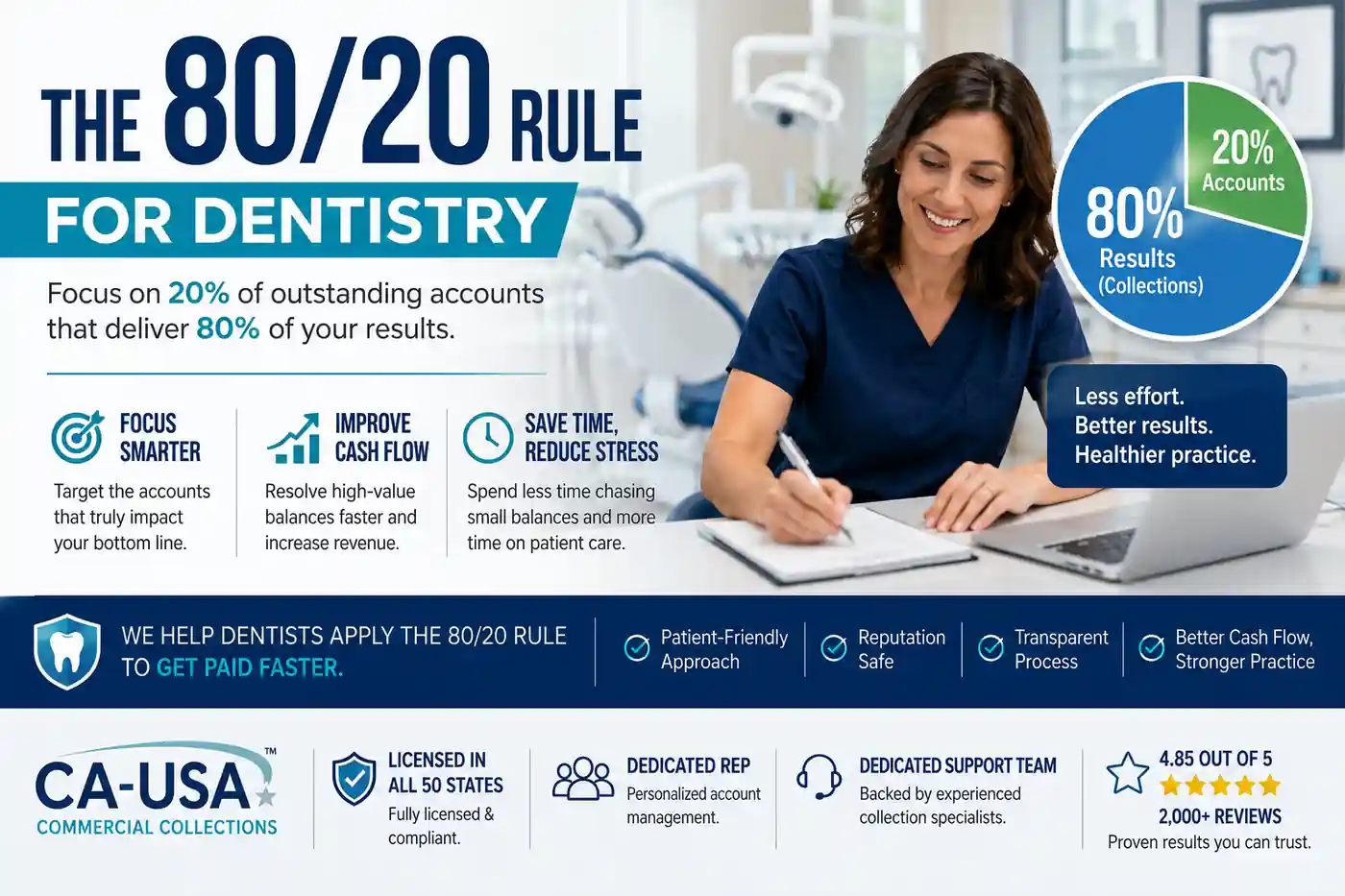
You already know that 20% of your patients account for 80% of your headaches. But did you know the same ratio drives most of your revenue, most of your referrals, and most of your preventable disease burden too?

The 80/20 rule — formally the Pareto Principle — is one of the most versatile lenses in modern dental practice. Here’s how it actually works, where it breaks down, and why it’s more relevant now than ever.


What the 80/20 Rule Means in Dentistry

The principle is simple: in any complex system, roughly 80% of outcomes flow from 20% of causes. In a dental context, that plays out in three distinct ways.

Clinically, the most severe and costly oral health problems — advanced periodontitis, deep carious lesions, early tooth loss — are disproportionately concentrated among patients who consistently skip preventive care. The inverse is equally powerful: the modest 20% effort of daily brushing, flossing, and biannual check-ups prevents the vast majority of expensive, irreversible damage. Prevention isn’t just good medicine. It’s the highest-leverage clinical act you perform.

Economically, practice data consistently shows that around 80% of revenue is generated by roughly 20% of patients — those who accept comprehensive treatment plans, show up reliably, and refer others. Meanwhile, 80% of scheduling disruptions (no-shows, late cancellations, chronic last-minute reschedulers) trace back to a recurring 20% of your patient panel. Understanding which group a patient belongs to changes how you invest your time.

In communication, the rule offers a quieter lesson: 80% of your chair-side conversation should build trust and explain the why behind a treatment in plain language. The technical detail — the clinical jargon and treatment mechanics — belongs in the remaining 20%. Patients don’t accept treatment because you’ve overwhelmed them with information. They accept it because they trust you.


The Genuine Advantages

The 80/20 framework earns its place because it forces focus in a profession where time is relentlessly scarce.

For prevention, it clarifies where clinical energy pays off most. Identifying the high-risk 20% of your panel — the patients with uncontrolled biofilm, poor home care habits, or unmanaged systemic risk factors — and intervening early is demonstrably more effective than reactive treatment after damage has occurred.

For practice growth, it shifts referral strategy. Rather than spreading outreach evenly across every GP in your referral network, a specialist who identifies and deliberately cultivates their top 20% of referring dentists will see compounding returns.

For treatment acceptance, the rule is a communication compass. Less clinical monologue, more empathetic dialogue. Fewer technical diagrams, more honest conversations about what disease will cost if left untreated.


Where It Falls Short

The 80/20 rule is a description, not a prescription — and that distinction matters clinically.

It oversimplifies risk. Oral disease doesn’t follow a tidy Pareto curve for every practice or every population. Genetics, socioeconomic status, systemic disease, medication side effects, and access to care all create distributions that resist neat ratios. Relying on the rule without granular patient data leads to blind spots.

It can quietly encode inequality. If your high-value 20% happen to be your most financially comfortable patients, optimizing your practice around them risks systematically under-serving patients with greater clinical need but less ability to pay. The business logic and the ethical logic of the 80/20 rule can pull in opposite directions — and it’s worth noticing when they do.

It’s a snapshot, not a GPS. Patient behavior and practice economics shift constantly. A 20% analysis done in 2022 may not reflect your panel today. Treating it as fixed rather than as a living, recurring measure will lead you astray.


Five Modern Reframings Worth Knowing

1. Baby Boomers Are Redefining the “High-Value 20%”

The boomer generation is retaining their natural teeth into old age at unprecedented rates — and they’re arriving with multi-specialty complexity: full-arch implant cases, long-term periodontal maintenance, medication-related xerostomia, and prosthetic needs layered on top of existing restorations. For many general practices, this cohort now constitutes the most valuable and most demanding 20% of the patient panel. Capacity planning, specialist networks, and scheduling models all need to reflect that reality.

2. Insurance Gaps Are Distorting the Revenue Equation

Fewer than half of American adults carry dental insurance, and for those who do, annual maximums have barely budged since the 1970s in real terms. This means the revenue-driving 20% is increasingly determined not by loyalty or clinical complexity, but by the ability to pay out-of-pocket. Membership plans, in-house financing, and transparent fee communication are no longer nice-to-haves — they’re the mechanism by which practices can serve a broader patient population without letting the 80/20 revenue split calcify around wealth.

3. AI Is Turning the Rule Predictive

The traditional 80/20 analysis looks backward — you identify your high-risk patients after patterns emerge. AI-powered radiograph analysis and caries risk modeling are beginning to flip that. Machine learning tools can now flag patients likely to develop disease before clinical signs appear, flag recall intervals that don’t match actual risk, and even predict no-shows with meaningful accuracy. The Pareto Principle remains the underlying logic, but AI operationalizes it prospectively rather than retrospectively.

4. The Oral-Systemic Link Raises the Stakes

The clinical evidence connecting periodontal disease to cardiovascular disease, Type 2 diabetes, adverse pregnancy outcomes, and Alzheimer’s disease has grown substantially over the past decade. This reframes your highest-risk 20% of dental patients not just as complex cases, but as individuals with elevated systemic risk. Treating them well isn’t just about saving teeth — it’s a meaningful contribution to whole-person health. That’s a compelling narrative for patient communication, for interdisciplinary collaboration, and for the broader positioning of dentistry in the healthcare system.

5. Teledentistry Expands Who the “20%” Can Reach

The hardest-to-reach patients — those in rural areas, those with dental anxiety, those who defer care for years until a crisis forces action — are disproportionately represented in the high-risk 20%. Teledentistry and asynchronous consultation tools create low-friction touchpoints that can intercept these patients earlier, triage risk remotely, and keep them connected to care between visits. The “preventive 20% effort” threshold drops considerably when patients don’t have to come in to access it.


The Practical Takeaway

The 80/20 rule won’t run your practice for you — but used honestly, it surfaces the questions worth asking: Who are the patients that drive the most impact, in both directions? Where is clinical effort preventing the most harm? Which referral relationships are worth investing in? And as AI tools, demographic shifts, and insurance economics change the landscape, which part of the 20% are you currently failing to reach?

That last question is probably the most important one. The Pareto Principle is at its most powerful not when it tells you where to focus more attention, but when it reveals who is being left out of the picture entirely.

Filed Under: debt recovery

by

Tennessee Dental Collections: Clinical, Compliant, and Community-Focused

Tennessee dentistry is built on community trust—from the fast-paced corridors of Nashville and Memphis to the family-oriented practices in Knoxville and Chattanooga. As patient responsibility continues to climb across the Volunteer State, dental practices face a delicate balance: recovering what is owed while maintaining the patient loyalty that keeps a practice thriving.

Collection Agency USA (CA-USA) offers a specialized approach tailored for Tennessee. We move beyond “debt collection” into Clinical Reconciliation, acting as a professional extension of your front office.

Protecting your practice’s reputation, CA-USA holds licenses in all 50 states, ensuring a safe approach for every patient interaction. We provide free litigation and bankruptcy scrubs with zero onboarding or annual fees. Our SOC 2 Type II and HIPAA-compliant systems ensure total data security, backed by a 4.85/5 rating from over 2,000 professional reviews. Delivering high recovery rates!

Need a Dental Collection Agency? Contact us


The “Volunteer State” Staffing Advantage

Tennessee dental practices are currently navigating a competitive labor market. When your highly trained staff spends hours on “collection calls,” your practice loses production time and employee morale.

We handle the financial friction so your team can focus on Patient Care. By outsourcing your AR to a clinical-first agency, you reduce staff burnout and ensure your lobby stays focused on health, not balances.


We Speak “Dental” (Clinical Literacy)

We don’t treat dental balances like a retail credit card. We understand the specific language of Tennessee dentistry. Whether it’s a dispute over a Contractual Write-off with BlueCross BlueShield of Tennessee or a misunderstanding regarding TennCare coverage, our team is trained to explain the clinical “why” behind the bill.

Our recovery specialists de-escalate patients by explaining their Explanation of Benefits (EOB) with clinical accuracy, resolving the debt without the need for aggression.


Revenue Recovery Built for Tennessee AR

We offer two transparent pricing models to suit any practice size:
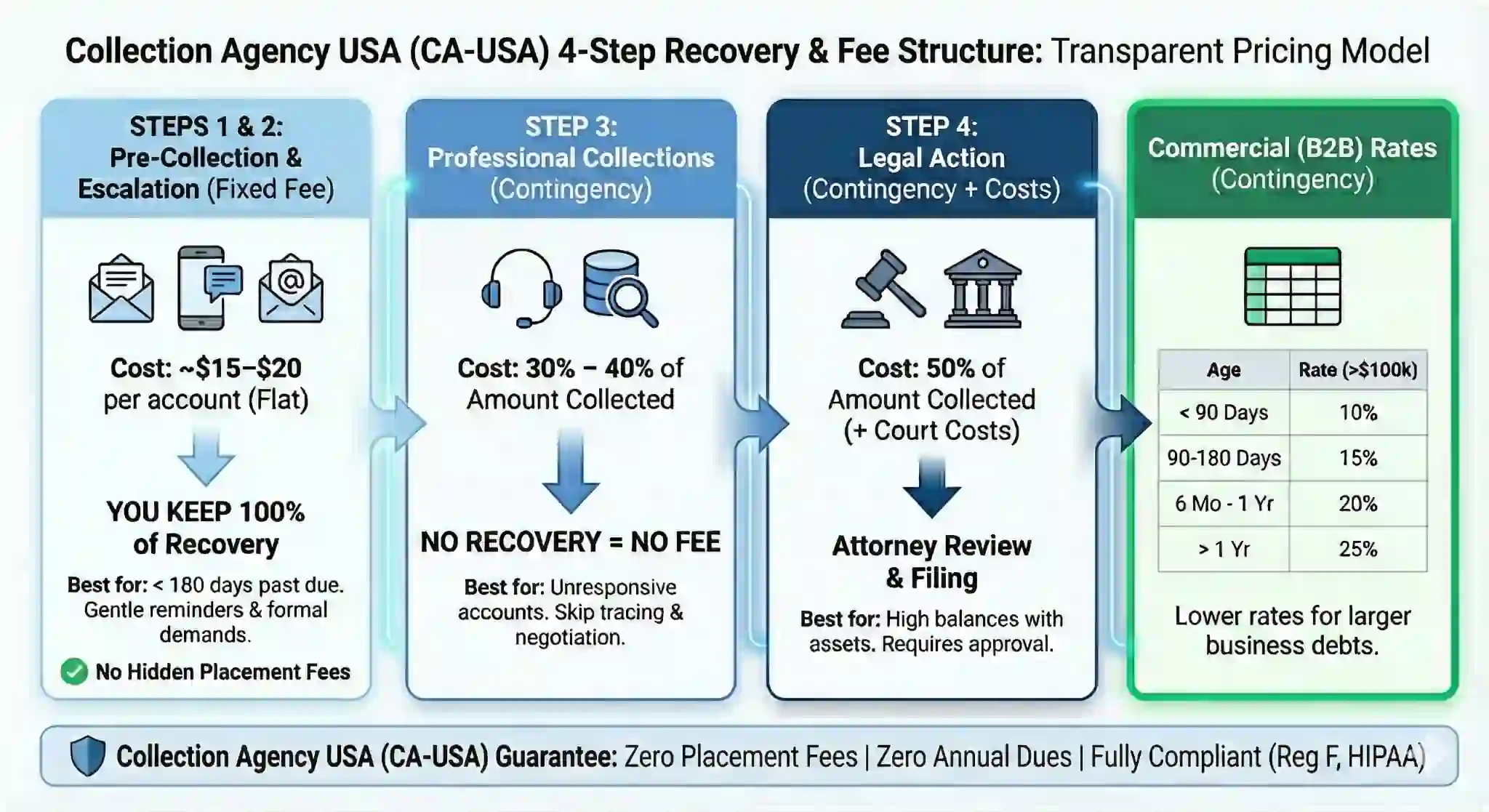
  • Fixed-Fee: $15 per account. You keep 100% of the recovered funds. Best for recent balances.

  • Contingency: 40%. No recovery, no fee. Ideal for older, high-friction accounts or “ghost” tenants.

The CPA Edge: Our $15 fixed-fee model is often treated as a tax-deductible business expense, effectively lowering your net cost while bringing immediate liquidity back to your clinic.


Protecting the “Music City” Reputation

In a state where community reputation is everything, one harsh billing conversation can turn into a negative Google or Healthgrades review overnight.

Our “Respectful Friction” model uses:

  • Firm Boundaries: Clear payment expectations.

  • Calm Language: Professional de-escalation.

  • Structured Options: Payment plans that fit Tennessee families.

We act as a neutral third party, protecting your practice from the emotional blowback of financial conversations.


Tennessee Compliance & Federal Shield

Navigating the regulatory landscape in Tennessee requires local expertise. Our process is fully aligned with:

  • Tennessee Collection Service Act (T.C.A. § 62-20-101)

  • Tennessee Consumer Protection Act (TCPA)

  • HIPAA Privacy & SOC 2 Type II Security

  • The No Surprises Act for billing transparency.


Recent Recovery Results

  • Nashville Multi-Specialty Clinic: Faced a backlog of aging AR due to insurance credentialing delays. CA-USA recovered 88% of the targeted balances within 60 days using our clinical de-escalation approach.

  • Knoxville Family Practice: A long-term patient “drifted” into non-payment. We secured a full settlement through a respectful payment plan, and the patient returned to the practice for their next cleaning.


Frequently Asked Questions

Will this increase my negative reviews?

Quite the opposite. Our clinical approach resolves confusion, which is the primary cause of billing-related complaints.

How do you handle insurance disputes?

We review the ledger through a clinical lens. If a patient claims “insurance should have paid,” we explain the specific policy limits or deductibles that led to the balance.

Do you report to credit bureaus?

Yes. For unresponsive accounts, reporting serves as a powerful motivator for resolution without the need for constant phone calls.

Need a TN Dental Collection Agency? Contact us

Filed Under: debt recovery

by

Ohio Dental Collections: Clinical, Compliant, and Community-Focused

blank

Ohio dentistry operates on a foundation of trust—from the high-volume urban centers of Columbus and Cleveland to the family-owned clinics in Cincinnati and Dayton. As we move through 2026, the “Patient-Responsibility Gap” is widening. With insurance plans evolving and Ohio-specific Medicaid shifts, Buckeye State dentists face a growing challenge: recovering balances without damaging the patient relationships they’ve spent decades building.

In a state where reputation is everything, Collection Agency USA provides a specialized approach that keeps your recovery efforts clinical, not combative.

Protecting your practice’s reputation, CA-USA holds licenses in all 50 states, ensuring a safe approach for every patient interaction. We provide free litigation and bankruptcy scrubs with zero onboarding or annual fees. Our SOC 2 Type II and HIPAA-compliant systems ensure total data security, backed by a 4.85/5 rating from over 2,000 professional reviews. Delivering high recovery rates!

Need a Dental Collection Agency? Contact us

Revenue Recovery Pricing (Built for Dental AR)

CA-USA gives Ohio dental offices two direct options:

  • Fixed-Fee: $15 per account (your practice keeps 100% of what’s recovered)
  • Contingency: 40% (no recovery, no fee)


Navigating the Ohio “Dental Labor Gap”

The 2026 dental landscape in Ohio is defined by a historic staffing squeeze. When your hygienists or front-desk coordinators are forced to act as “bill collectors,” you aren’t just losing money on uncollected fees—you’re losing expensive billable hours.

By outsourcing your AR to a clinical-first agency, you allow your team to focus on production, not prosecution. We handle the friction so your staff can focus on filling the schedule and providing patient care.


We Speak “Dental” (From Delta to Dento-Skeletal)

Most collection agencies treat a dental balance like credit card debt. We don’t. We understand the nuances of Contractual Write-offs, Coordination of Benefits (COB), and the difference between a Prophy and an SRP.

Our recovery specialists are trained to review the ledger through a clinical lens. When a patient says, “I thought insurance covered my crown,” we don’t argue—we explain the “Alternate Benefit” clause in their specific Ohio plan. This clinical literacy de-escalates the patient and gets the balance resolved without a single “combative” word.


Revenue Recovery Built for Ohio Dental AR

We offer two transparent pricing models designed to fit the specific cash-flow needs of Ohio dental offices:

  • Fixed-Fee: $15 per account. Your practice keeps 100% of the recovered funds. Best for recent balances.

  • Contingency: 40%. No recovery, no fee. Ideal for older, high-friction accounts.

The CPA Advantage: That $15 fixed fee is often a tax-deductible business expense. Many Ohio offices find that this model pays for itself by reducing internal staff burnout while bringing immediate liquidity back to the clinic.


Ohio-Specific Regulatory Fortification

The regulatory landscape for medical and dental debt in Ohio is evolving. From the Ohio Consumer Sales Practices Act (CSPA) to new 2026 shifts in how Ohio Medicaid (CareSource/Molina) is managed through Delta Dental, we provide a compliance shield.

We perform a “Medicaid Scrub” before outreach. If a patient has transitioned to state-funded care, we alert you immediately to prevent a PR disaster or a compliance violation. We protect your license as fiercely as we protect your cash flow.


From the North Coast to the Ohio River

Whether you are a high-tech implant center in Dublin, a pediatric clinic in Shaker Heights, or a rural practice in Athens, we understand your patient demographic. We know that a patient in Cincinnati has different expectations than one in Youngstown. Our outreach strategy is “localized”—using regional communication styles that resonate with Ohioans’ values of hard work and personal responsibility.

Protecting the “5-Star” Reputation

Ohio is a highly competitive, review-driven market. Our “Respectful Friction” model uses recorded call reviews and structured payment options to ensure your practice remains a 5-star destination. We act as a neutral third party, insulating your team from emotional blowback.


Ready to Recover Your Ohio Dental AR?

Don’t let unpaid balances cause staff fatigue or production disruption. Let your team stay in patient care while we handle the reconciliation.

Contact Collection Agency USA today to start your recovery process.

Filed Under: debt recovery

by

Florida Dental Collections That Stay Clinical – Not Combative

blank

Florida dentistry runs on speed and volume—Miami to Orlando to Tampa—while patient responsibility keeps climbing with every plan reset.

Along the I-4 corridor and the I-95 spine, practices are delivering premium care… then waiting too long for balances to close.
When accounts linger, it’s not just cash flow. It’s staff fatigue, schedule disruption, and a front desk stuck in conflict.

Protecting your practice’s reputation, CA-USA holds licenses in all 50 states, ensuring a safe approach for every patient interaction. We provide free litigation and bankruptcy scrubs with zero onboarding or annual fees. Our SOC 2 Type II and HIPAA-compliant systems ensure total data security, backed by a 4.85/5 rating from over 2,000 professional reviews. Delivering high recovery rates!

Need a Dental Collection Agency? Contact us

Revenue Recovery Pricing (Built for Dental AR)

CA-USA gives Florida dental offices two direct options:

  • Fixed-Fee: $15 per account (your practice keeps 100% of what’s recovered)
  • Contingency: 40% (no recovery, no fee)

Use the fixed-fee lane when the patient is reachable and the balance is recent. Use contingency for older, inconsistent, or higher-friction accounts.

The CPA Edge: Why $15 Often Pays for Itself

That $15 fixed-fee can often be treated as a tax-deductible business expense after CPA guidance.
In practice terms: many offices reduce the true net cost while still bringing money back into the clinic now—without adding stress to the team.

The Patient-Responsibility Gap (Florida is Feeling It Hard)

Dentistry is increasingly patient-pay. High deductibles. Annual maximums that run out early. Partial coverage that creates confusion at checkout.

Then life happens. Storm season. A job change. A new insurance card.
Patients don’t always refuse. They drift. And drift turns into delay, then avoidance.

That’s why we treat recovery like a clinical process: confirm the facts, lower the temperature, and guide the account to resolution.

Peace of Office: Let Your Staff Stay in Patient Care

Your front desk shouldn’t spend their best hours negotiating payment behavior.

Outsourcing account reconciliation reduces burnout and protects your culture. It also improves the patient experience because your team stops being forced into hard conversations at the worst possible moment—right after treatment, right before the next patient, right in the lobby.

Respectful Friction: Protect the 5-Star Practice

Florida is a review-driven market. One harsh billing conversation can turn into a public complaint on Google or Healthgrades by dinner.

Our model uses respectful friction: firm boundaries, calm language, and structured options. We work with the patient, not against them—while staying aligned with HIPAA privacy expectations and keeping your reputation insulated from emotional blowback.

And because Florida is diverse, we also use Spanish-speaking specialists to remove language barriers, reduce miscommunication, and close balances faster.

Recent Recovery Results (Clinical Context)

Result 1 — Senior Living / Complex Care Specialist (Sarasota)

  • The Case: A specialist serving older adults in Sarasota had accounts building after treatment completion—multiple responsible parties, missed statements, and confusing insurance timing.

  • The Respectful Intervention: We began with verification: updated addresses, clarified contact pathways, then delivered a respectful reconciliation message offering two clear outcomes—structured plan or accelerated settlement. We used secure digital outreach to reduce phone friction and document patient consent-based communication steps.

  • The Financial Result: The practice recovered meaningful balances without upsetting families, without staff escalation, and without destabilizing patient trust.

Result 2 — Orthodontic Practice (Orlando / Lake Nona Area)

  • The Case: An orthodontic office near Orlando’s Lake Nona medical hub faced recurring payment breakdowns tied to mid-treatment plan changes, autopay failures, and guardians assuming “insurance has it handled.”

  • The Respectful Intervention: We stabilized the account narrative fast—confirming responsibility, updating contact points, and using bilingual outreach when needed. When disputes surfaced, we kept it clinical: explain the timeline, show the balance logic, and offer a resolution path that preserves goodwill.

  • The Financial Result: Collections improved without dismissing patients mid-treatment. The office regained monthly cash consistency and kept schedules full.

The Security Suite: Patient Scrub Before Outreach Intensifies

Before pressure rises, we protect your practice with a layered screening process:

  • Litigation check to identify high-risk profiles early

  • Bankruptcy check to avoid improper pursuit

  • USPS address verification to reduce misdirected outreach

  • Skip tracing for outdated contact information

Quality Control + Modern Channels

Every practice worries about “rogue collectors.” You should.

That’s why all calls are recorded and reviewed for quality assurance—protecting your brand and reducing “review-bombing” risk.
We also use secure, HIPAA-conscious email/text when appropriate to speed up responses, especially for Florida patients who screen unknown calls.

Areas of Expertise

Healthcare & dental (Hospitals/Clinics)
Dental (General/Orthodontics)

Regulatory Landscape: Florida + Federal Guardrails

Florida offices require compliance discipline and communication discipline.

We align our process with FDCPA standards, Florida’s FCCPA (Fla. Stat. §559.72) restrictions on prohibited practices, and HIPAA privacy safeguards for patient information.
We also respect the patient sensitivity created by the No Surprises Act, which has elevated expectations around billing clarity, estimates, and dispute handling. Your messaging must be accurate, defensible, and calm—especially when patients are already frustrated.

FAQs Florida Dental Leaders Ask

How do you handle patient disputes without losing loyalty?
We de-escalate first. We clarify the clinical and billing facts, document the options, and guide the patient toward a resolution that feels fair—not hostile.

Will outsourcing increase complaints or negative reviews?
Not when handled correctly. Our respectful friction approach, recorded call reviews, and structured communication reduce reputation risk.

Do Spanish-speaking specialists actually help recovery?
Yes. When language barriers drop, confusion drops. And when confusion drops, patients resolve faster.

Need a Florida Collection Agency? Contact us

Filed Under: debt recovery

by

Texas Dental Balances Don’t Age Gracefully, Recover Them Clinically

blank

Texas dentistry moves fast—DFW to Houston, with high-volume schedules, rising patient responsibility, and tighter insurance timelines.

Along the I-35 and I-45 corridors, practices are treating more complex cases while front desks are asked to “also become collections.”

When accounts linger in AR, the real cost shows up as staff burnout, schedule gaps, and delayed reinvestment into care.

Protecting your practice’s reputation, CA-USA holds licenses in all 50 states, ensuring a safe approach for every patient interaction. We provide free litigation and bankruptcy scrubs with zero onboarding or annual fees. Our SOC 2 Type II and HIPAA-compliant systems ensure total data security, backed by a 4.85/5 rating from over 2,000 professional reviews. Delivering high recovery rates!

Need a Dental Collection Agency? Contact us

Revenue Recovery Pricing (Simple, Transparent)

CA-USA gives Texas dental offices two clean lanes:

  • Fixed-Fee: $15 per account (you keep 100% of what’s recovered)

  • Contingency: 40% (no recovery, no fee)

Use the fixed-fee lane when the account is recent and the patient is likely to engage. Use contingency when the balance has resistance, history, or complexity.

Money-Saver Tip: The CPA Edge

That $15 fixed-fee is often eligible as a tax-deductible business expense after CPA review.
In plain terms: many practices “neutralize” the cost on the back end while still bringing cash back to the clinic now.

Why Texas Practices Struggle With the Patient-Responsibility Gap

Clinical production is up. Patient out-of-pocket is up faster.

High deductibles, partial coverage, waiting periods, and confusing EOB language create a perfect storm where good patients fall behind without realizing it. Then the account sits. Then the story changes.
That’s why we treat recovery like a clinical workflow: diagnose the barrier, reduce friction, and close the account with integrity.

Peace of Office: Keep Your Front Desk Out of the Fire

Your team didn’t join dentistry to negotiate balances all day.

Outsourcing reconciliation protects your culture. It also protects your patient experience.
Instead of tense phone calls at checkout, your front office stays focused on scheduling, case acceptance, and retention—where revenue is actually created.

The Respectful Friction Model (Reputation-Safe by Design)

Texas practices live and die by reviews. One heated billing call can snowball into a public complaint on Google or Healthgrades.

Our model uses respectful friction: firm boundaries, calm language, and a structured resolution path. We work with patients, not against them—while staying aligned with HIPAA expectations on privacy and communication.
We don’t “pressure.” We professionally reconcile.

And because Texas is diverse, we also deploy Spanish-speaking specialists to remove language barriers and speed up resolution without confusion.

Recent Recovery Results — Texas Clinical Context

Result 1 — Cosmetic/Implant Specialist (Plano)

  • The Case: A cosmetic/implant-focused practice in Plano had multiple accounts tied to high-dollar treatment where patients completed care but paused payment after insurance posted adjustments. The balances weren’t “hostile”—just stuck in silence.

  • The Respectful Intervention: We initiated a patient-first sequence: verify statements, confirm contact routes, then deliver a clear reconciliation message using secure channels. We offered two options—short plan or one-time settlement—documented in writing to eliminate misunderstandings.

  • The Financial Result: The practice recovered a meaningful portion of aging AR in weeks, with patients staying calm and cooperative. No staff escalation. No reputation damage.

Result 2 — Orthodontic Practice (Near the Dallas Medical District)

  • The Case: An orthodontic office serving families near the Dallas Medical District / UT Southwestern had recurring payment breakdowns after schedule changes, mid-treatment insurance shifts, and missed autopays.

  • The Respectful Intervention: We rebuilt clarity: verified payer responsibility, re-confirmed plan terms, and used bilingual outreach when needed. For disputes, we documented the “why” behind the balance and offered a structured cure plan before the account could spiral.

  • The Financial Result: The office stabilized collections without dismissing patients, improved monthly cash consistency, and kept the treatment pipeline intact.

The Security Suite: “Patient Scrub” Before Contact Intensifies

Every account is screened before it becomes messy:

  • Litigation check to identify high-risk patterns and litigious patients.

  • Bankruptcy check to avoid improper pursuit

  • USPS address verification to reduce misdirected outreach

  • Skip tracing when contact information is outdated

Quality Control + Modern Channels

To prevent “rogue collector” behavior and protect your brand, all calls are recorded and reviewed.
We also use secure, HIPAA-aligned email/text where appropriate to increase response speed—especially for Texas patients who don’t answer unknown numbers.

Areas of Expertise

Healthcare & dental (Hospitals/Clinics)
Dental (General/Orthodontics)

Regulatory Landscape (Texas + Federal Guardrails)

Texas offices need partners who understand both firmness and rules. Our workflows align with federal FDCPA standards, HIPAA privacy expectations, and Current Texas debt collection requirements that restrict unfair or abusive practices.
We also stay mindful of the No Surprises Act, which has increased patient sensitivity around estimates, billing clarity, and dispute pathways—meaning your reconciliation messaging must be clean, accurate, and defensible.

FAQs Texas Dental Offices Ask

How do you handle patient disputes without losing loyalty?
We de-escalate first. We clarify the account logic, show the path to resolution, and offer structured options. Patients don’t need a fight—they need certainty.

Will outsourcing hurt our reviews?
Not when it’s done correctly. Our respectful friction approach is designed to reduce “review-bomb” risk through calm language, quality controls, and documented communication.

Do Spanish-speaking patients resolve faster with bilingual outreach?
Often, yes. When language barriers disappear, confusion drops—and payment decisions happen sooner.

Need a Texas Collection Agency? Contact us

Filed Under: debt recovery

by

Close More Deals: Sales Enablement for Collection Agencies

What would actually help you close more deals—faster?

Let’s skip the fluff. If you’re selling collections, you’re fighting for trust, speed, and proof. Below is a tight plan that plugs the biggest enablement gaps and turns hesitation into signed agreements.


1) Case Studies & ROI Calculators

The gap: Prospects can’t picture outcomes in their world (dental, trade schools, utilities, B2B).

Build:

  • Vertical one-pagers (2–3 per sector): Problem → Action → Result → Testimonial → Compliance note.

  • Simple ROI tool (sheet or web form):
    Inputs: accounts/month, avg balance, age, current recovery, fee model (Step-2 fixed fee vs Step-3 contingency).
    Outputs: expected recovery $, net ROI after fees, breakeven placement age.
    Talk track: “You’re collecting 0% on 120-day accounts. Early Step-2 clients average 18–28% recovered in 30–60 days.”
    KPIs: ROI runs/week, % of opps sent a case study, win rate when ROI is used.


2) Digital Marketing That Feeds Sales

The gap: Not enough high-intent leads.

Build:

  • Two focused landing pages:

    1. Early-stage collections for Trade Schools

    2. B2B collections for Staffing/Leasing/Engineering
      Include proof (logos/testimonials), calculator embed, compliance badges (HIPAA/Reg F/state licensing), and a tight FAQ.

  • Ads: Google + LinkedIn around: “collection agency for [vertical],” “fixed-fee collections,” “patient balances,” “past-due B2B invoices.”

  • Lead magnets: Vertical playbook, self-pay checklist, Reg-F outreach guide.
    Workflow: Auto-route by vertical → instant rep sequence → consult set within 48 hours.
    KPIs: Cost per lead, SAL rate, demo rate, page conversion %, inbound win rate.


3) Outbound Prospecting (Lists, Scripts, Automation)

The gap: Stale lists, short sequences, generic messaging.

Build:

  • Segmented lists by title and company size, pre-checked for state licensing needs.

  • 12-touch / 21-day sequence (email, phone, LinkedIn):
    1–3: pain + quick proof
    4–6: ROI invite
    7–9: social proof + 60-second video
    10–12: value “breakup” note with checklist/link

  • Talk-track: opener → vertical pain → early-placement angle → soft CTA (“5-min fit check?”).
    Paste-ready snippet:
    “We move 60–90-day accounts into fixed-fee Step-2; contingency only if needed. Two-minute ROI calc using your numbers?”
    KPIs: Meetings per rep per week, reply rate by touch, licensed-state coverage.


4) Referral & Association Partnerships

The gap: Referrals happen by accident, not design.

Build:

  • Referral kit: co-branded one-pager, intro email, referral form, “ideal referral” profile, safe-harbor language.

  • Association play: sponsorship + quarterly webinar + member offer (free AR audit or first-batch discount).

  • Channel tiers: Silver (finder’s fee), Gold (co-marketing + events), Platinum (API/portal feed).
    Rep move: Ask every happy client for one intro. Host a Quarterly Partner Day with benchmarks and wins.
    KPIs: Active partners, partner-sourced opps, close rate, revenue per partner.


5) Objection Handling & Enterprise Selling

The gap: Strong on features, weaker on risk, legal, security, and multi-threading.

Build:

  • Objection vault with short scripts + proof for:
    Reputation risk, “fees are high,” “we do it in-house,” “we already use an agency,” ROI doubt, compliance/legal (Reg F, HIPAA, state laws).

  • Deal desk: security checklist, license map, pricing guardrails, redline playbook, complaint-resolution SOP.

  • Weekly 30-minute role-plays recorded and scored.
    Micro-script (Reputation):
    “We collect like you’d speak to a long-time client—documented, compliant, respectful. That’s why second placements succeed without harming relationships.”
    KPIs: Win rate vs top objections, sales cycle length, # stakeholders per deal, security/legal approval time.

Filed Under: debt recovery

  • Page 1
  • Page 2
  • Page 3
  • Interim pages omitted …
  • Page 6
  • Go to Next Page »

Primary Sidebar

blank

Unpaid Bills? Contact Us

    Please prove you are human by selecting the truck.


    Email : support@CollectionAgencyUsa.com
    Ph: 1-844-666-7890

    Recent Posts

    • The 80/20 Rule in Dentistry: The One Framework Every Practice Needs Right Now
    • Tennessee Dental Collections: Clinical, Compliant, and Community-Focused
    • Ohio Dental Collections: Clinical, Compliant, and Community-Focused
    • Florida Dental Collections That Stay Clinical – Not Combative
    • Texas Dental Balances Don’t Age Gracefully, Recover Them Clinically
    • Close More Deals: Sales Enablement for Collection Agencies
    • 10-Step Checklist for California Dentists Before Hiring a Collection Agency
    • Trusted New York Debt Collection Services: Fully Compliant Nationwide
    • Need a Collection Agency in Pennsylvania?
    • Better than a Bot: Boost Debt Recovery with AI Collections

    Featured Posts

    • Trusted New York Debt Collection Services: Fully Compliant Nationwide
    • Maximize Recovery, Minimize Costs with Fixed-Fee Demands
    • Strategies to Negotiate Payment Plans and Settlements with Debtors
    • Ensuring Your Online Contract is Legally Binding

    COPYRIGHT: SACHING.COM | 2024 | ALL INFORMATION ON THIS WEBSITE IS FOR GENERAL INFORMATION ONLY AND IS NOT AN EXPERTS ADVICE. VISIT OUR HOME PAGE TO KNOW MORE ABOUT US.