Applying the Pareto Principle (the 80/20 Rule) to dental practice management transforms how clinical owners and financial controllers approach revenue growth, patient communications, and accounts receivable (AR).
In a typical dental office, operational dynamics follow an asymmetrical pattern: 20% of core activities, high-value procedures, and structured intake protocols generate 80% of net collections, while 20% of unmanaged accounts receivable bottlenecks cause 80% of written-off bad debt.
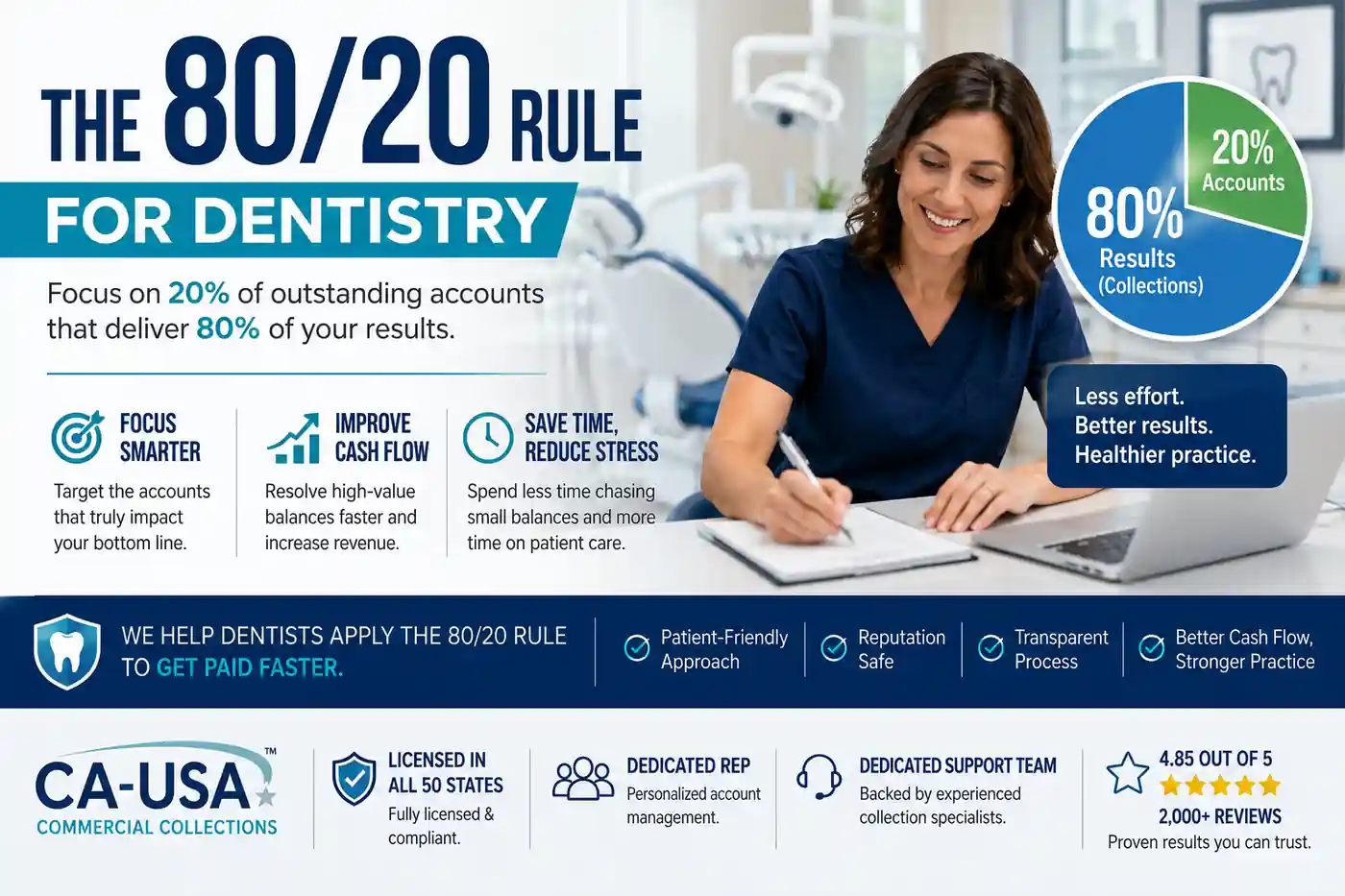
By shifting focus from reactive administrative tasks to high-leverage clinical and financial strategies, practices optimize case acceptance, eliminate intake friction, and stabilize cash flow while staying fully compliant with HIPAA and state debt collection regulations.
Quick Answer: What is the 80/20 Rule in Dental Practice Management?The 80/20 Rule in dentistry states that 80% of a practice’s net production and collection issues stem from 20% of root causes. In practice management, 20% of patients and comprehensive treatment plans generate 80% of practice profitability. In Revenue Cycle Management (RCM), 20% of delinquent accounts (often aged over 60–90 days) represent 80% of uncollected bad debt risk, requiring targeted early-stage automated outreach and structured third-party recovery workflows. |
Want to isolate your practice’s 20% high-risk accounts receivable? Contact us
The Dental 80/20 Operational & Financial Matrix
| Practice Management Dimension | The 20% High-Leverage Drivers (Focus Area) | The 80% Operational Impact (Net Result) |
| Accounts Receivable (AR) & Recovery | 20% of delinquent patient ledgers (aged past 60–90 days with unverified insurance or missing guarantors). | 80% of bad debt write-offs and administrative staff time spent chasing past-due balances. |
| Treatment Acceptance & Production | 20% of clinical offerings (restorative, implants, clear aligners, and comprehensive crown/bridge work). | 80% of net production revenue and practice fee-for-service profitability. |
| Front Desk Intake & Patient Friction | 20% of intake gaps (unsigned financial policies, lack of co-pay collection at check-in, unverified PPO eligibility). | 80% of billing disputes, claim rejections, and delayed post-procedure payments. |
| Doctor-Patient Communication | 20% time spent speaking / 80% time active listening during treatment presentations. | 80% higher case acceptance without pressuring patients or causing financial anxiety. |
3 Core RCM Strategies to Apply the 80/20 Rule to Dental Billing
Applying the Pareto Principle to Revenue Cycle Management (RCM) allows dental offices to focus administrative energy on the 20% of billing activities that prevent 80% of bad debt and administrative overhead.
| RCM Focus Area | The 20% Operational Action (High Leverage) | The 80% Financial Outcome |
| 1. High-Risk AR Segmentation | Isolate accounts at 60 days past due; route insurance claim delays to billing specialists and patient responsibility balances to flat-fee third-party demand letters. | Eliminates 80% of bad debt write-offs by escalating aged ledgers before recovery rates plummet. |
| 2. Front-End Intake Protocols | Mandate real-time PPO eligibility checks 24–48 hours prior to service, collect estimated co-pays upfront, and secure signed financial policies. | Prevents 80% of patient payment disputes, billing confusion, and post-procedure statement delays. |
| 3. Active Listening Financial Counseling | Spend 80% of the financial consultation listening to patient concerns and 20% presenting structured, multi-tiered payment options. | Increases case acceptance on major procedures while securing reliable post-treatment payment commitments. |
Detailed Strategy Breakdown
1. Identify and Isolate the “20% High-Risk” Accounts
In most practice management software (Dentrix, Eaglesoft, Open Dental), aging reports show that the vast majority of written-off debt originates from a small subset of neglected accounts. Rather than treating every past-due account with blanket statements, segment ledgers at 60 days: route claim-adjudication issues to your insurance billing team, and transition patient balances to structured, fixed-fee third-party demand outreach.
2. Standardize Front-End Intake Workflows
The majority of patient non-payment occurs due to billing confusion rather than deliberate refusal. By standardizing the 20% of front-desk tasks that eliminate downstream friction—such as upfront co-pay collection and pre-treatment eligibility checks—practices streamline cash flow and lower administrative burden.
3. Apply Active Listening to Financial Presentations
When patients delay necessary treatment, financial anxiety is often the core barrier. Investing time in understanding patient financial constraints allows practice managers to present transparent payment plans, resulting in higher case acceptance and prompt voluntary payments.
Recommended Dental AR Escalation Timeline
-
Days 1–30: Time-of-Service Collections & Digital Statements
Verify insurance benefits prior to appointment. Collect estimated co-pays and deductibles at check-in. Issue immediate digital statements (SMS/Email with single-click pay links) for remaining balance.
-
Days 31–60: Reconcile EOBs & Courtesy Nudges
Post Explanation of Benefits (EOB) payments promptly. Send a secondary courteous digital reminder to patients with remaining balances, highlighting convenient payment portal options.
-
Days 61–90: CA-USA Fixed-Fee Third-Party Demand
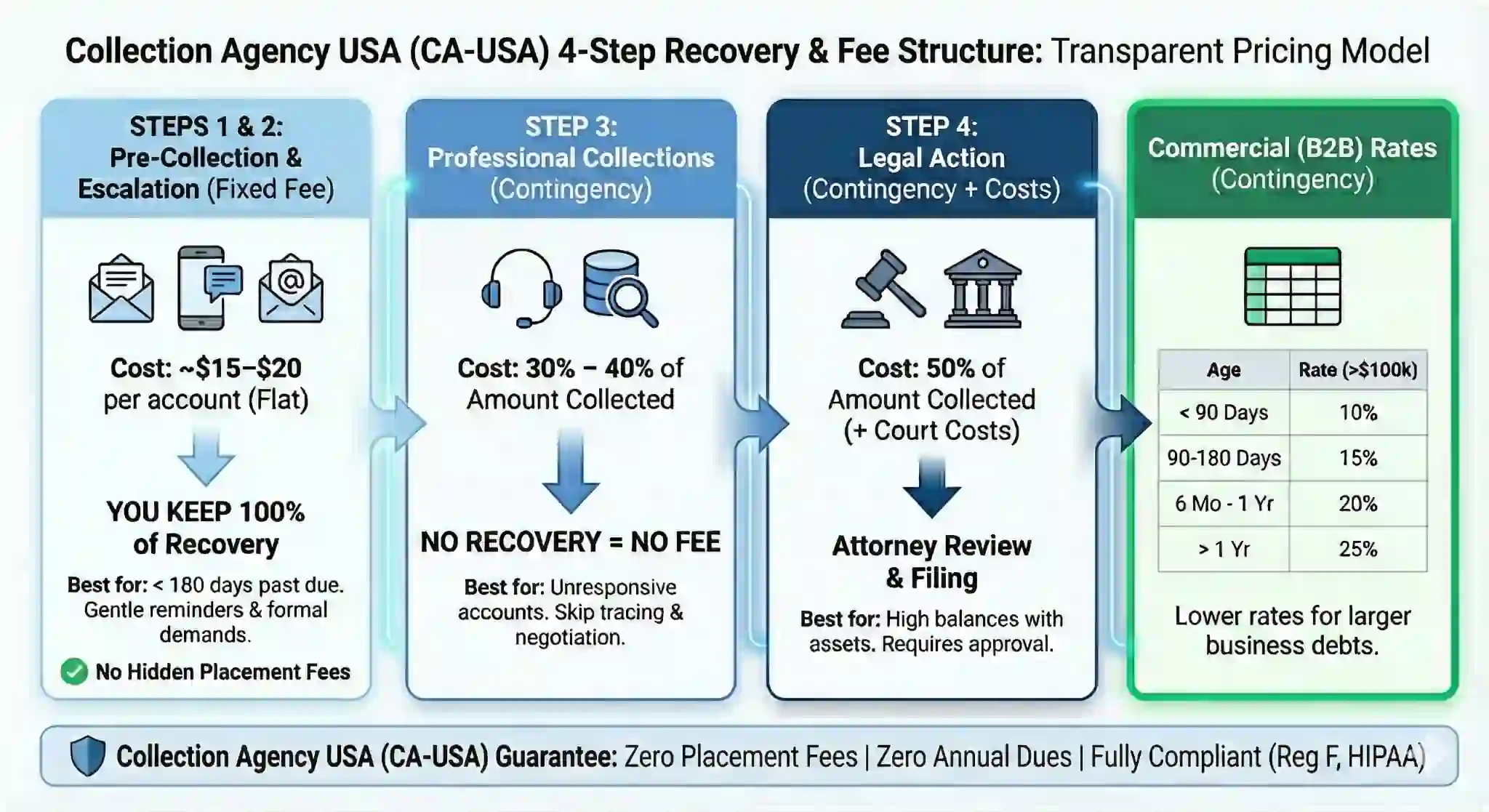
Transfer uncollected ledgers to an official CA-USA third-party demand letter. For a low flat fee ($15–$30), a third-party notice prompts immediate resolution while allowing your practice to retain 100% of recovered funds directly.
-
Days 91+: Contingency Recovery or Account Audit
Evaluate remaining uncollected accounts for full-service contingency recovery or formal debt resolution, ensuring full compliance with state-specific collection laws and CFPB medical credit reporting guidelines.
Frequently Asked Questions
How does the 80/20 rule help reduce dental practice overhead?
By identifying the 20% of administrative bottlenecks (such as manual claim re-submissions and repetitive phone calls to past-due patients) that consume 80% of staff time, practices can automate routine billing, streamline front-desk workflows, and significantly lower operational overhead.
Why is 20% of dental accounts receivable responsible for 80% of bad debt?
Accounts left unaddressed past 60–90 days suffer from exponentially declining recovery rates. Unresolved insurance disputes, incorrect patient contact details, or a lack of signed financial agreements quickly compound into uncollectible write-offs if structured escalation is delayed.
How can a dental practice use the 80/20 rule to increase case acceptance?
Practices increase case acceptance by focusing clinical presentation time on the 20% of patient concerns (cost, fear, or scheduling) that cause 80% of treatment hesitations, combining active listening with transparent, multi-tiered payment options.
Revenue Recovery Built for Dental Practices
We offer two transparent pricing models to suit any practice size:
-
Fixed-Fee: $15 per account. You keep 100% of the recovered funds. Best for recent balances.
-
Contingency: 40%. No recovery, no fee. Ideal for older, or high-friction accounts.