Banks, credit unions, and fintech companies can use a specialized overdraft fee collection agency to recover charged-off checking accounts, negative balances, NSF charges, and unpaid overdraft fees. CA-USA combines account validation, respectful consumer outreach, flexible payment arrangements, nationwide collection capabilities, and performance-based pricing to help financial institutions improve recoveries while protecting customer relationships and reducing compliance risk.

Managing charged-off Demand Deposit Accounts (DDA) requires a precise balance between maximizing financial recovery and adhering to strict regulatory standards. When negative balances, Non-Sufficient Funds (NSF) charges, and overdraft fees go unpaid, financial institutions face mounting operating losses. Partnering with a specialized, CFPB-compliant collection agency allows banks, credit unions, and fintech platforms to restore lost revenue while protecting institutional reputation and consumer trust.
⭐️ Trusted Financial Recovery Partner
Backed by a 4.8-star Google rating across 1,500+ verified client reviews, nationwide licensing, SOC 2 Type II data security, easy to use, and strict CFPB compliance, CA-USA provides risk-free, diplomatic debt recovery for financial institutions across all 50 states.
Quick Answer: What is an Overdraft Collection Agency?
An overdraft collection agency is a specialized financial recovery partner that collects charged-off Demand Deposit Accounts (DDA), negative balances, and non-sufficient funds (NSF) fees for banks, credit unions, and fintech lenders. Operating strictly under CFPB, Reg E, and FDCPA compliance standards, a specialized agency recovers financial institution losses without exposing the bank to class-action litigation or brand damage.
Navigating Regulatory Compliance in DDA Collections
Collecting on negative bank balances and overdraft fees carries heightened scrutiny from federal regulators and consumer protection agencies. Generic debt collection tactics expose financial institutions to severe legal liabilities and public backlash.
To safely recover charged-off deposit accounts, your recovery program must address key regulatory frameworks:
-
CFPB Guidance & “Junk Fee” Scrutiny: The Consumer Financial Protection Bureau aggressively monitors financial institutions for improper overdraft practices, illegal transaction re-sequencing, and unvalidated fee assessments.
-
Regulation E (12 CFR Part 1005) Opt-In Verification: Collections can only proceed on overdraft accounts where the account holder provided explicit, compliant opt-in consent for automated teller machine (ATM) and one-time debit card transactions.
-
Fair Debt Collection Practices Act (FDCPA) & Regulation F: All written communications, call frequencies, and electronic notices must adhere strictly to debt collection validation and contact rules.
A specialized banking collection agency validates account documentation prior to initiating outreach—ensuring every account pursued meets federal compliance standards.
Comparing Recovery Strategies for Charged-Off Deposit Accounts
| Recovery Feature | In-House Bank Recovery | Standard B2B Agency | CA-USA Specialized DDA Recovery |
| CFPB & Reg E Auditing | High Internal Workload | Low / Generic Compliance | Automated Account Validation |
| Data Security & Core Integration | Manual Account Export | Manual CSV Uploads | SOC 2 Type II Encrypted & Core Integration |
| Licensing Scope | Local / Regional | Partial State Coverage | Fully Licensed Nationally (50 States) |
| Brand Protection | Maximum Control | High Public Backlash Risk | Diplomatic & Consumer-Safe Outreach |
| Recovery Rate (90+ Days) | 10% – 15% Average | 15% – 20% Average | 30% – 45% Average |
A Diplomatic Approach to Negative Balance Recovery
Bank account holders often accumulate negative balances due to sudden financial hardship, unexpected recurring fees, or administrative confusion rather than intentional fraud. Treating consumers with empathy yields significantly higher recovery rates.
Our DDA recovery workflow focuses on constructive resolution:
-
Account Audit & Data Scrubbing: Verifying Regulation E consent records, auditing fee calculations, and cross-checking accounts against bankruptcy and military databases (SCRA).
-
Multi-Channel Soft Communication: Reaching account holders via diplomatic written notices, SMS, and email options compliant with Regulation F digital disclosure standards.
-
Structured Payment Arrangements: Offering flexible installment plans or fee-mitigation settlements that allow consumers to cure their negative balance without financial collapse.
-
Credit Bureau Reporting Compliance: Reporting delinquent accounts accurately to major credit bureaus in compliance with FCRA regulations, motivating settlement while preserving consumer rights.
Why Banks and Credit Unions Partner With Us
-
Nationwide Licensing & Legal Coverage: Fully licensed, bonded, and compliant to recover debts in all 50 U.S. states.
-
SOC 2 Type II Data Security: Enterprise-grade encryption, audited portals, and strict data privacy protocols ensuring total customer confidentiality.
-
Dedicated Account Managers & Support: Award-winning customer support providing real-time reporting, transparent account status tracking, and responsive assistance.
-
Core Banking Integration: Seamless data workflows compatible with major core processing platforms (Fiserv, FIS, Jack Henry, and custom fintech APIs).
-
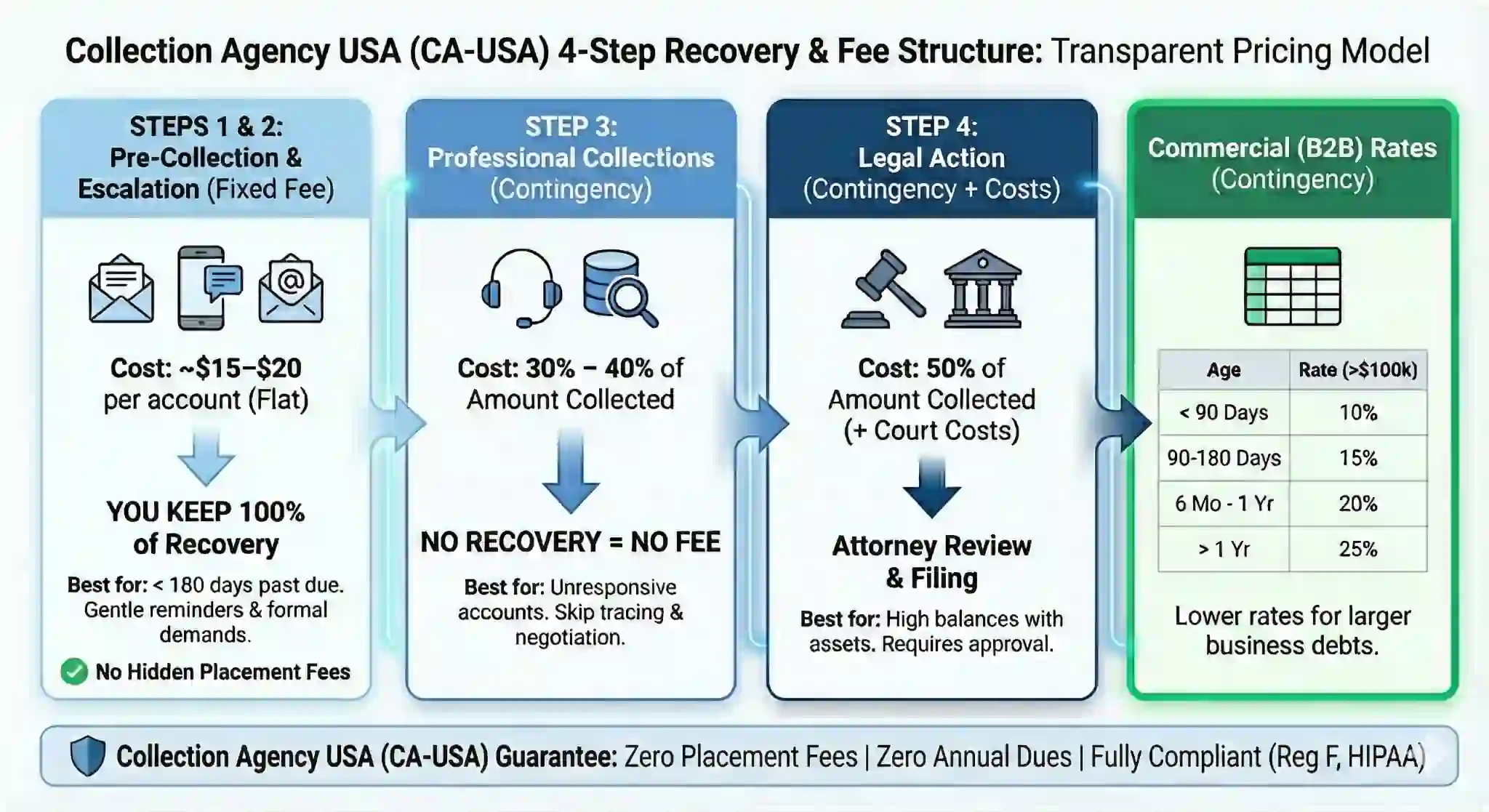
Performance-Based Contingency: No upfront fees—we only earn a fee when we successfully recover funds for your institution.
Need a Collection Agency: Contact us
Serving banks and credit unions nationwide
CA-USA offers Fixed-fee services for about $16 per account and Contingency fee services for 40%.
Frequently Asked Questions
Is it legal for a collection agency to collect on bank overdraft fees?
Yes. Collection agencies can legally recover charged-off overdraft balances provided the original financial institution complied with Regulation E opt-in requirements and CFPB disclosure rules.
How do collection agencies recover negative bank account balances?
Specialized agencies use advanced skip-tracing, soft written notices, structured repayment plans, and credit bureau reporting to recover charged-off DDA balances ethically.
Why should banks outsource charged-off overdraft accounts to an agency?
Outsourcing frees internal banking operations, ensures compliance with strict CFPB debt collection rules, and significantly boosts recovery rates on aged 90+ day negative balances.
What happens if an account holder disputes an overdraft fee?
When a dispute occurs, the agency halts collection activity immediately and requests original account statements, Reg E disclosures, and deposit agreements from the financial institution to validate the debt.