New Jersey dental debt collection requires more than simply sending overdue patient balances to an agency. Dental practices have to protect patient relationships, handle insurance and billing disputes correctly, and use a collection partner that understands both healthcare privacy and New Jersey-specific collection requirements.
That matters even more in a densely connected state where reputation travels quickly. A poor collection experience can cost a practice far more than the original balance, so the right strategy is professional, documentation-driven, and designed to recover payment without unnecessarily damaging trust.
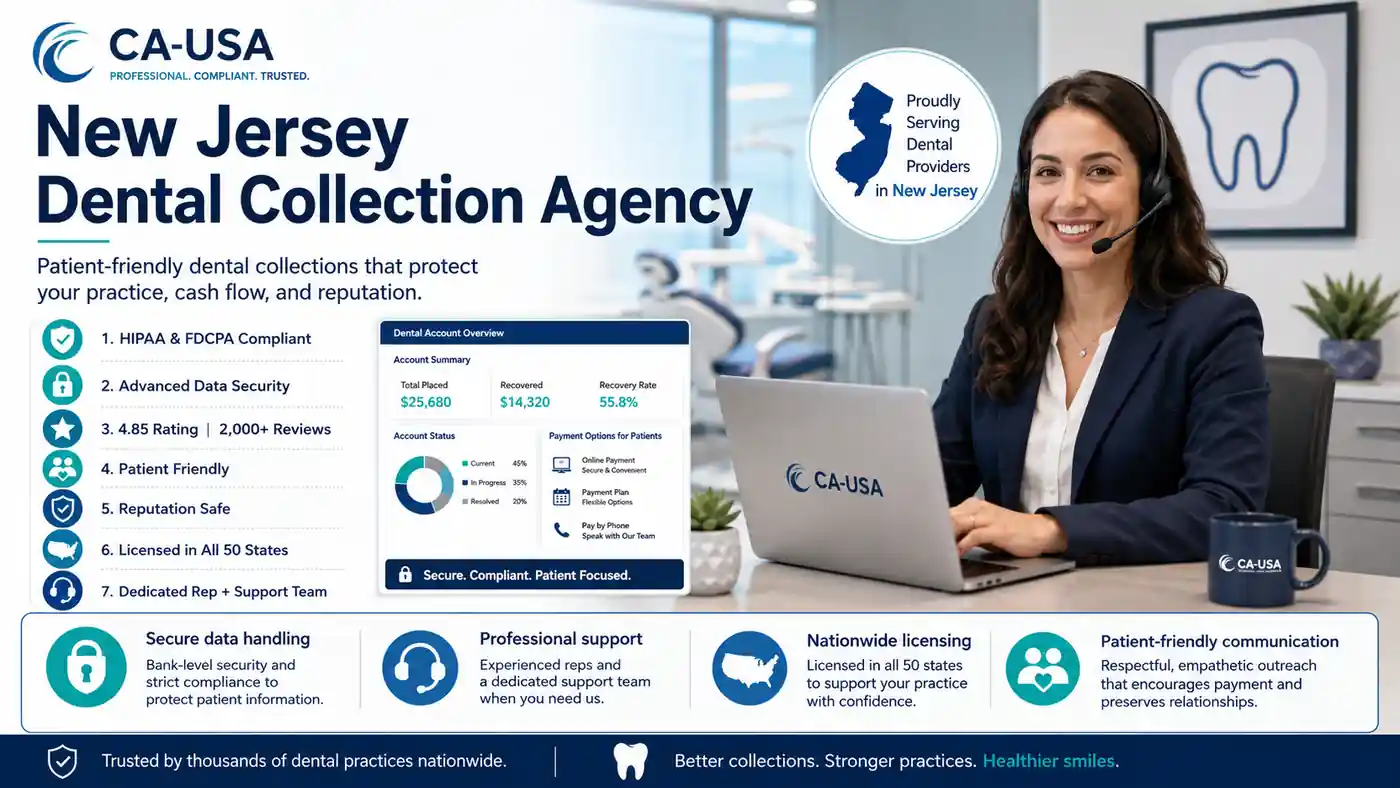
For the broader checklist on evaluating a dental collection partner, see how to choose a dental collection agency. This article focuses specifically on New Jersey considerations.
| Quick answer: New Jersey dental collections must balance strict state rules with tight-knit community trust. Patient records, including X-rays, generally can’t be withheld over an unpaid balance, except when that balance is specifically for the unpaid diagnostic services that produced them. The state gives practices 6 years to pursue a written contract or open account claim, and late fees are only collectable if the patient signed a written agreement disclosing them upfront. |
Need a New Jersey Dental Collection Agency? Contact us
3 Things Most NJ Dental Practices Get Wrong
1. Assuming you can hold records hostage.
You generally can’t, with one real exception. New Jersey’s dental board rules let a practice withhold records only when the unpaid balance is specifically for the initial diagnostic services that produced them, not for later treatment. Once that diagnostic charge is settled, or if the balance in question is from later work, the records go out regardless of what’s still owed.
2. Treating credit reporting as a real threat.
It mostly isn’t anymore, and hasn’t been for a while. The major credit bureaus voluntarily stopped reporting paid debt and balances under $500 as their own 2022–2023 policy decision, not a state or federal mandate. Leaning on “we’ll report this” as your main leverage is leaning on something that increasingly doesn’t happen. A confirmed patient-responsibility balance, verified against the EOB rather than assumed, is worth far more than credit-report pressure; see overcoming denied claims and unpaid dental bills for how to get that verification right in the first place.
3. Skipping the paperwork that makes late fees collectable.
Under the New Jersey Consumer Fraud Act, you can charge late fees or administrative finance charges, but only if the patient or guarantor signed a written financial policy disclosing those exact terms before treatment began. A fee added after the fact, with nothing signed upfront, is very hard to defend.
A Simple Escalation Timeline
- Days 1–30: Collect estimated out-of-pocket costs at check-in. Send a digital statement as soon as the insurance EOB posts.
- Days 31–60: One soft courtesy follow-up, ideally offering a payment plan option, not just a repeated bill.
- Days 61–90: A fixed-fee third-party demand letter. Patients pay you directly; you keep 100% of what’s recovered.
- Day 90+: Evaluate the account for contingency recovery, weighing it against New Jersey’s 6-year statute of limitations, which gives you real runway but shouldn’t be treated as a reason to wait.
Revenue Recovery Built for Dental Practices
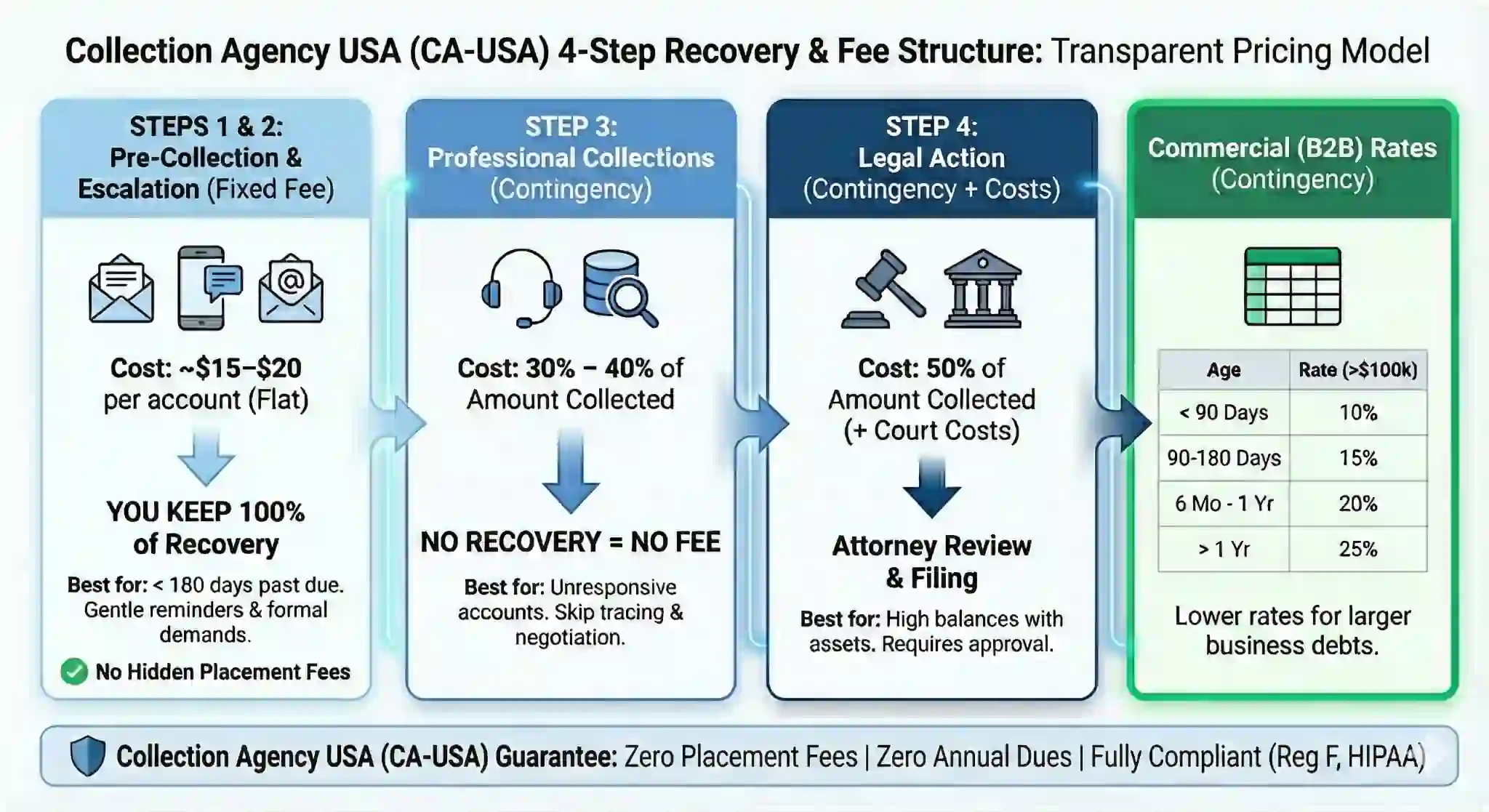
We offer two transparent pricing models to suit any practice size:
-
Fixed-Fee: $15 per account. You keep 100% of the recovered funds. Best for recent balances.
-
Contingency: 40%. No recovery, no fee. Ideal for older, or high-friction accounts.
Frequently Asked Questions
Can a New Jersey dental practice withhold X-rays if a patient has an unpaid bill?
Generally no, with one specific exception. New Jersey dental board rules allow a practice to withhold records only when the unpaid balance is for the initial diagnostic services that produced those specific records, not for unrelated treatment charges. Outside that narrow situation, records must be provided on request, typically within 14 days, with only a limited reproduction fee allowed.
What is the statute of limitations on dental debt in New Jersey?
New Jersey generally allows 6 years to pursue a breach of contract or open account claim, with the clock starting at the date of default or the last voluntary payment. That’s a meaningful window, but recovery odds still decline the longer an account sits, so it’s not a reason to delay action.
Can New Jersey dental practices charge late fees on past-due balances?
Yes, but only if it was agreed to in writing beforehand. Under the New Jersey Consumer Fraud Act, late fees or administrative finance charges are only collectable if the patient or guarantor signed an explicit financial policy disclosing those terms before treatment, not added on after the balance is already past due.
If the guarantor and the patient aren’t the same person, who’s actually responsible for the balance?
Whoever signed the financial responsibility agreement at intake, not necessarily whoever received the treatment. This comes up often in family accounts and after a divorce: a private custody arrangement between two parents doesn’t bind your practice, which was never a party to it. Collection follows the guarantor named on your own paperwork, and handling it diplomatically matters here more than almost anywhere, see managing client relationships during debt recovery for how to keep that family account from turning into three lost patients instead of one resolved balance.
Is small claims court a realistic option for a smaller unpaid balance?
Often, yes. New Jersey’s Special Civil Part handles small claims up to $5,000, and the broader Special Civil Part up to $20,000, both designed for self-representation with lower fees and faster hearings than a standard lawsuit. For a balance in that range, it can be a faster, cheaper path to a judgment than a formal collection escalation, worth considering before assuming a lawsuit means hiring outside counsel.