Most guides to choosing a dental collection agency read like a simple checklist: HIPAA compliance, 50-state licensing, good reviews, check the boxes and you’re safe. That’s not wrong, it’s just incomplete.
The right agency for a dental office also needs to understand insurance EOBs well enough not to collect money a patient’s insurer actually owes, know the difference between a patient stalling on payment and a patient with a genuine complaint about their treatment, and offer a soft, non-collections first step that protects the patient relationship before anything formal begins. Get those three right, alongside the standard compliance checklist, and you’ll avoid the mistakes that actually damage a dental practice’s reputation, not just the ones a generic checklist warns you about.

Selecting a collection agency for your dental office can be genuinely difficult to get right, and the stakes are higher than for most businesses: your “debtors” are also your patients, your referral source, and sometimes your neighbors.
Need a Dental Collection Agency? Contact us |
In-house debt collection in dental practices can be costly and distracts from patient care. While handling it internally might protect your bottom line on paper, it strains patient relationships in practice. Kinum, Inc. offers a different path: efficient collections that start with gentle, effective reminders rather than a hard escalation, so your team can concentrate on patient care and leave the collecting to us.
Green Flags: What a Strong Dental Collection Agency Looks Like
- Reputation Protection. Opt for an agency that employs friendly yet effective tactics, written notices and calls, to recover unpaid bills without harming your practice’s image.
Our 4.8-star rating across more than 2,000 reviews isn’t just a vanity number here, it’s the track record behind that reputation-protection promise. Clients who were worried about their image going into collections came out the other side with both the balance recovered and the patient relationship intact often enough that it shows up in the rating itself.
- Real dental and medical experience. Hundreds of medical and dental clients, not a handful, is a reasonable bar. Multilingual collectors, including Spanish speakers, are a plus.
- Practice management integration. Ask whether the agency connects directly with Dentrix, EagleSoft, Open Dental, or your specific system. Manually re-entering account data for every submission is friction your front desk doesn’t need.
- Audited data security. SOC audit certifications, SSL on any online portal, two-factor authentication.
- HIPAA compliance as a baseline, not a bonus. Non-negotiable for anything medical-related.
- Licensing in all 50 states. Covers you when a patient relocates after the balance is placed.
- A believable recovery-rate answer. Ask what they actually recover, and whether they offer any guarantee.
- Reviews that look real. Some negative reviews are inevitable, but the overall pattern should be positive, and should mention things like payment-plan flexibility and respectful collectors. Understanding debtor psychology helps explain why even a well-handled collection can draw the occasional sour review.
- Genuine legal fluency. FDCPA, TCPA, HIPAA, Regulation F, GLBA, and ongoing training for collectors on all of them, not just a list of acronyms on a webpage. It’s also worth knowing what a medical collection agency legally can’t do during recovery, since that boundary matters as much as what they can.
- A real client portal. Batch processing, a dedicated account representative, and a central support number as backup.
- Flexible, low-commitment terms. Use-as-needed, no minimums, no hidden costs, free credit bureau reporting, skip tracing, free bankruptcy screening (worth understanding how bankruptcy actually affects collections before assuming a screened-out account is a lost cause), and litigious-patient checks.
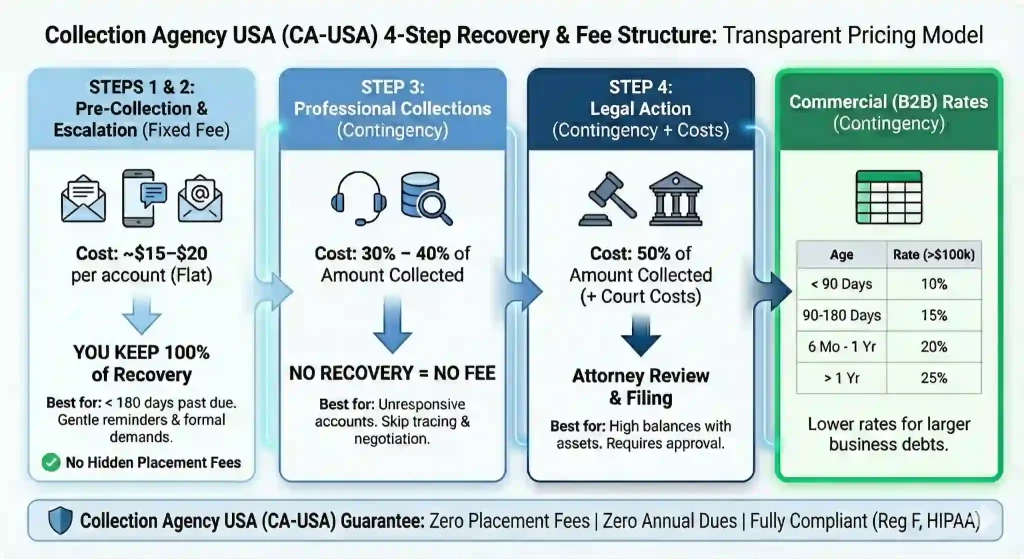
- A genuine fixed-fee option. Most agencies only offer contingency because that’s where the money is for them. Fixed-fee demands are often the lowest-friction way to protect both cash flow and reputation, and may be deductible as a business expense (confirm with your accountant).
Red Flags: Reasons to Walk Away
For the fuller version of this idea, our guide to red flags in any collection agency applies just as much to dental-specific vendors as general ones. The dental-specific version:
- Rock-bottom pricing. Licensing, staffing, and compliance cost real money. An agency charging far less than competitors is often cherry-picking easy, high-balance accounts and quietly ignoring the rest of your portfolio.
- No fixed-fee option at all. If every conversation pushes straight to contingency, ask why.
- Vague or evasive answers about recovery rates. If they won’t give you a real number, assume the real number isn’t good.
- A small, unstable-feeling operation. Recent regulatory changes have raised the cost of running a compliant agency, pushing a number of smaller shops out of business.
- No clear compliance training process, and no training for your own staff either. Knowing the acronyms and training collectors on them regularly are two different things. If staff training gaps are already a challenge inside your own practice, an agency that doesn’t reinforce good habits on your side of the relationship isn’t helping.
Frequently Asked Questions
How does a collection agency avoid accidentally collecting money a patient’s insurance actually owes?
This requires understanding dental billing at a level most general collection agencies never bother with, CDT procedure codes, how an Explanation of Benefits breaks down what’s covered versus patient responsibility, and the fact that an EOB can change after the fact if a claim gets reprocessed. An agency that doesn’t understand this can end up pursuing a patient for a balance the insurer was actually going to pay, turning a clean collection into a real dispute. This is exactly the kind of confusion behind denied claims and unpaid dental bills more broadly, so the account needs to reflect confirmed patient responsibility, not just whatever the statement says, before it’s pursued.
What happens if a patient disputes the collection because they were unhappy with the dental work itself, a failed crown, an uncomfortable denture, rather than the bill?
This is a genuinely different situation than a patient who simply doesn’t want to pay. Pursuing collections aggressively against a patient with a live clinical grievance is one of the more common ways a routine billing matter turns into a State Dental Board complaint or a malpractice claim threat, since the patient feels cornered into escalating. A collection agency with real dental experience should recognize a clinical dispute versus an ordinary payment excuse, and pause to loop the practice back in rather than continuing to press an account that’s really a treatment complaint wearing a billing complaint’s clothes.
Should a dental office go straight to formal collections, or is there a lighter first step?
A lighter first step is usually the better move, and it’s worth asking any agency you’re evaluating whether they even offer one. A soft “pre-collect” phase, friendly reminders sent under the practice’s own letterhead rather than a collection agency’s, gives patients a chance to pay without the relationship ever formally becoming a collections matter. Given how much dental practices depend on repeat hygiene visits and referrals, preserving that softer first touch matters more here than in almost any other industry.
What if a patient with an old unpaid balance is still an active patient of record, scheduled for future appointments?
Worth asking any agency how they handle this, since it’s easy to overlook. A patient simultaneously receiving a collection call about an old balance and a reminder for their next cleaning is an awkward, reputation-risking overlap most general collection agencies never think to check for. An agency with real dental experience should flag active patients differently, at minimum coordinating timing with the front desk.
Beyond checking client reviews of the agency, is there anything else worth verifying about the agency itself?
Yes, whether the agency has its own unresolved regulatory complaint history, not just what their clients say about them. State attorneys general and the CFPB’s consumer complaint database are both public and searchable, and a pattern of formal complaints against the agency itself tells you something client testimonials alone won’t.