Managing accounts receivable (AR) in a modern dental practice requires a delicate balance between cash flow optimization, billing accuracy, and patient relationship management. As patient out-of-pocket responsibilities increase under high-deductible plans and PPO copay structures, dental front desks often struggle to keep up with insurance verification, EOB reconciliations, and overdue balance follow-ups.

This comprehensive guide breaks down how dental office managers and practice owners can streamline their AR workflows, ensure full compliance with federal and state privacy laws, and resolve aged patient ledgers efficiently.
The Dental AR Aging & Recovery Matrix
To effectively manage uncollected balances, dental billing teams must categorize past-due ledgers based on account type and billing friction points:
| Account / Ledger Category | Primary Billing Friction Point | Root Cause of Delay | Operational Resolution Strategy |
| PPO Copays & Co-insurance | Uncollected Out-of-Pocket Balances | Patient assumes insurance covers 100% or misinterprets EOB adjustments. | Conduct pre-service eligibility checks, issue clear post-EOB statements, and offer digital payment portal links. |
| Family Guarantor Accounts | Multi-Dependent Unpaid Ledgers | Balances for multiple family members are split across individual patient charts. | Group chart balances under the primary Head of Household / Guarantor for consolidated family billing statements. |
| High-Ticket Treatment Plans | Cosmetic, Implant, or Ortho Defaults | Patient defaults on internal payment arrangements or abandons multi-phase care. | Audit completed clinical phases against unearned treatment fees; establish interest-free third-party financing. |
| In-House Membership Plans | Defaulted Recurring Subscriptions | Expired or declined credit cards on automated practice membership plans. | Set up automated card updater features and send digital payment retry links via SMS/Email. |
Nexa provides reputation-safe, equipped with all 50-state collections license, offering free credit reporting, free litigation/bankruptcy scrubs, and zero onboarding fees. Secure – SOC 2 Type II & HIPAA compliant.
Need a Collection Agency? Contact us
4 Essential Pillars of Compliant Dental AR Management
1. Family Guarantor Ledger Consolidation
In most Dental Practice Management Software (PMS), family members maintain individual patient charts. However, financial responsibility rests with the primary guarantor. Sending separate billing notices for individual dependents causes confusion and delays payment. Practices should consolidate multi-dependent balances into single itemized guarantor statements.
2. PPO EOB Reconciliation vs. Patient Balance Billing
Improper balance billing can lead to contract violations with PPO insurance networks. Before pursuing past-due balances, billing staff must verify that insurance adjustments match contracted fee schedules. Patients should only be billed for true deductibles, non-covered services, or agreed-upon copays.
3. Auditing Mid-Treatment Defaults & Unearned Fees
For multi-phase procedures (such as dental implants, crown & bridge work, or clear aligners), patients who discontinue treatment mid-way should not be billed for the entire estimated treatment plan. Practices must cross-reference clinical progress notes to adjust off unearned fees, billing only for completed clinical steps.
4. Practice Management Software (PMS) Workflow Integration
Automating ledger tracking directly within your PMS reduces manual data entry and human error. Key systems to leverage include:
-
Dentrix & Eaglesoft: Utilize built-in aging reports and batch-statement generation for 30-, 60-, and 90-day buckets.
-
Open Dental & Curve Dental: Set up automated text and email billing reminders with integrated online payment links.
Regulatory Compliance Standards in Dental Billing
When managing past-due patient balances in California and across the U.S., practices must strictly adhere to regulatory guidelines:
-
HIPAA & PHI Security: All digital billing communications, text message links, and third-party vendor transfers must protect Protected Health Information (PHI). Third-party billing services must sign a formal Business Associate Agreement (BAA).
-
California Rosenthal Act & State Rules: For practices operating in California, collection activities must comply with state consumer communication standards and disclosure requirements under the Rosenthal Fair Debt Collection Practices Act.
-
Credit Reporting Mandates: Federal CFPB guidelines impose a $500 minimum balance threshold and a 365-day grace period before medical or dental debts can be reported to credit bureaus.
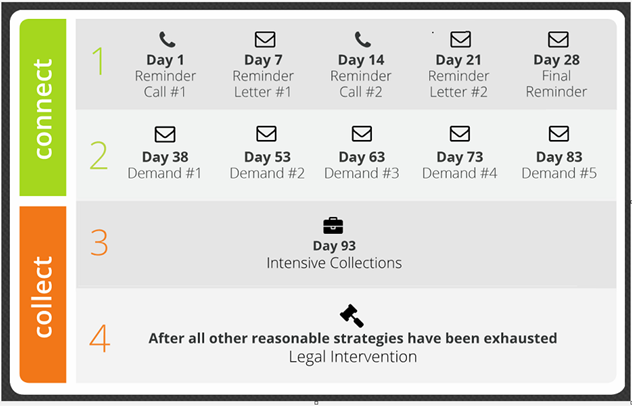
Recommended 4-Step Dental AR Escalation Timeline
-
Days 1–30 (Post-Service / Post-EOB): Issue initial billing statement immediately after insurance claim adjudication. Send digital payment links via text or email.
-
Days 31–60 (Friendly Reminder): Send a secondary reminder statement. Front-desk staff should follow up via phone during hygiene recare scheduling calls.
-
Days 61–90 (Formal Financial Counseling): Issue a firm, itemized statement outlining payment options, interest-free installment arrangements, or hardship applications.
-
Days 91+ (Third-Party Escalation): Transfer severely aged ledgers to a specialized, HIPAA-compliant healthcare recovery partner to prevent uncollectible debt write-offs.
Frequently Asked Questions
What is an acceptable Accounts Receivable (AR) benchmark for a dental practice?
A healthy dental practice should aim to keep total AR under 1x average monthly production. Additionally, no more than 10–15% of total AR should exceed 90 days past due.
How should a practice handle split financial responsibility in divorced family accounts?
The practice should enforce payment terms based on the original signed financial agreement and enrollment documentation on file, rather than attempting to mediate private divorce decrees between parents.
Can a dental practice charge late fees or interest on overdue balances?
Yes, provided that late fee policies and interest charges are clearly disclosed and agreed to in the signed patient financial consent form prior to treatment.