• Skip to main content
  • Skip to primary sidebar

Collection Agency

  • Home
  • Pricing
  • Contact Us for Collections

debt recovery

by

Types of Medical Debts that Cannot be Reported

medical credit reporting restrictions

Not all medical debts can be reported or remain on patient’s credit history. In fact, major credit scoring agencies, such as FICO and VantageScore, have adjusted their scoring models in recent years, diminishing the negative impact of unpaid medical bills on a consumer’s credit score compared to other types of debt like credit card debt or loans.

This does not restrict ability of collection agencies to pursue medical debt recovery. In fact if a medical debt is assigned for professional debt collectors within 180 days, chances of recovery are a lot higher.

Medical debts that are not report-able to credit bureaus typically include:

  1. Debts in Grace Period: Medical debts often have a grace period before they can be reported to credit bureaus. As of recent guidelines, there is a 1-year waiting period to give individuals time to resolve disputes with insurance companies or to arrange payment plans. This means medical debts cannot be reported until 365 days after the account was reported as delinquent.
  2. Small Debts: Some credit bureaus have policies against reporting minor debts. For example, debts under $500  (the threshold can vary) may not be reported.
  3. Paid Debts: Previously, paid medical debts could remain on credit reports for up to seven years. However, major credit bureaus have changed their policies, and now paid medical debts are either not reported or removed from the credit report shortly after being paid off.The three major credit bureaus — Equifax, Experian, and TransUnion — have agreed to remove paid medical debt from credit reports, a policy shift aimed at reducing the negative impact of such debt. As of July 2022, paid medical collection debt is no longer included on consumer credit reports.
  4. Debts Covered by Insurance: Debts that are eventually paid by insurance should not be reported to credit bureaus. If a debt is reported and later paid by insurance, it should be removed from the credit report.
  5. Debts in Dispute: If a medical debt is being disputed, it should not be reported until the dispute is resolved. The Fair Credit Reporting Act (FCRA) provides protections for consumers, including the right to dispute inaccuracies.

Unpaid medical debt can remain on a credit report for up to seven years, similar to other types of collection accounts. Although lesser, still this can long-term affect credit access and costs.

It’s important to note that the policies and practices regarding the reporting of medical debt can vary by credit bureau and are subject to change due to regulations or policy updates. Consumers have rights under the Fair Credit Reporting Act (FCRA) to dispute inaccuracies in their credit reports, including inaccurately reported medical debt.

Filed Under: debt recovery

by

Collection Agency for Police Departments

Police Department

Police departments may require the services of a collection agency for several reasons, primarily to manage and recover unpaid fines, fees, parking tickets, and other debts owed to them.

Managing unpaid fines and fees in-house requires resources and expertise police departments typically do not possess. Hiring an experienced collection agency approach allows them to focus on their core mission of public safety, while collection agencies, adept in legal and regulatory compliance, efficiently recover debts. Outsourcing also helps police departments avoid the potential negative public perception associated with debt collection activities.

We have been delivering excellent collection results for Law Enforcement agencies

References available – Serving Nationwide – Contact us

Here’s a breakdown of why a Collection Agencies are so important for Law Enforcement agencies:

  1. Recovery of Unpaid Fines and Fees: Individuals often incur fines for various violations, including traffic tickets, parking tickets, and other minor infractions. If these fines are not paid, the amount owed can accumulate over time. Police departments might not have the resources or infrastructure to pursue these unpaid fines aggressively. A collection agency, with its expertise in debt recovery, can effectively pursue these individuals to recover unpaid amounts.
  2. Efficiency and Focus on Core Responsibilities: Policing involves a wide range of responsibilities, from maintaining public order to investigating crimes. By outsourcing the recovery of unpaid debts to a specialized agency, the police department can focus more on these core responsibilities, ensuring that their resources are utilized in areas where they are most needed.
  3. Maximizing Revenue: Unpaid fines and fees represent a significant source of revenue that, if not collected, can affect the budget and financial planning of a municipality or police department. Collection agencies have the tools, technology, and strategies to maximize the recovery of these funds, which can then be used to support public safety initiatives, training, equipment, and other essential services.
  4. Legal and Regulatory Compliance: The process of debt collection is regulated by laws such as the Fair Debt Collection Practices Act (FDCPA) in the United States, which sets strict guidelines on how debts can be collected. Collection agencies are well-versed in these regulations and ensure that their collection practices are compliant, reducing the legal risk to the police department.
  5. Public Relations: By outsourcing debt collection, police departments can distance themselves from the potentially negative perception of pursuing debt themselves. This can help maintain a more positive public image, as the direct involvement in debt collection can sometimes lead to public relations issues.

Filed Under: debt recovery

by

Impact of Bankruptcy on Debt Collection: Options and Restrictions

Recovering debt during debtor's Bankruptcy
When a debtor files for bankruptcy, it dramatically alters the landscape for creditors and collection agencies aiming to recover outstanding debts. The implications of bankruptcy on debt recovery processes are profound and multifaceted, affecting various aspects of collection activities. Here’s an in-depth look at how a debtor’s bankruptcy impacts the ability of collection agencies to recover debts, with details and examples:

  1. Checking the Date of Bankruptcy: It’s crucial for collection agencies to verify the date of the debtor’s bankruptcy filing to ascertain whether the debt they are attempting to collect falls within the bankruptcy case’s scope. Debts incurred after the bankruptcy filing date are not covered by the automatic stay or discharge provisions.
     For example, if a debtor files for bankruptcy on June 1, but incurs a new debt on July 15, a collection agency could pursue this new debt without violating bankruptcy protections.
  2. Automatic Stay: One of the most immediate effects of a bankruptcy filing is the imposition of an automatic stay. This legal provision halts nearly all collection efforts against the debtor the moment the bankruptcy petition is filed.
     For example, if a collection agency is pursuing payment through phone calls or has initiated legal action to recover the debt, these activities must cease immediately. The automatic stay is designed to protect debtors from harassment and give them breathing room while their bankruptcy case is processed.
  3. Priority of Claims: Bankruptcy proceedings categorize creditors into different tiers, with secured creditors typically at the top. Secured debts are those backed by collateral, such as a mortgage on a house or a loan for a car. These creditors have a lien on the debtor’s property and may have a right to repossess or foreclose on the collateral if the debt is not paid. Unsecured creditors, which often include credit card companies, medical bill collectors, and unsecured personal loans, generally receive lower priority. In a Chapter 7 liquidation case, a secured creditor might repossess a vehicle if the debtor fails to make payments, whereas an unsecured creditor might receive little to no repayment if the debtor’s assets are insufficient.
  4. Discharge of Debts: A fundamental aspect of bankruptcy is the potential discharge of debts, which can effectively eliminate a debtor’s legal obligation to pay certain types of debts. In Chapter 7 bankruptcy, this might include credit card debt, medical bills, and personal loans, freeing the debtor from these financial burdens. Chapter 13 bankruptcy, on the other hand, involves a repayment plan over three to five years, potentially leading to the discharge of remaining unsecured debts upon completion.
     For instance, a debtor owing $30,000 in credit card debt might have this amount significantly reduced or discharged through bankruptcy, leaving collection agencies unable to recover the full amount.
  5. Bankruptcy Estate and Trustee’s Role: Upon filing for bankruptcy, the debtor’s assets are gathered into a bankruptcy estate, overseen by a trustee. This trustee evaluates the assets and determines how to distribute them to creditors, following the priorities set by bankruptcy laws. If a collection agency has a claim, it must file this with the court to be considered for payment from the estate. The trustee might sell non-exempt assets of a debtor, such as a second vehicle or non-primary residence, to pay creditors.
  6. Prohibited Actions and Penalties: Engaging in collection activities after the filing of a bankruptcy petition can lead to severe consequences. For example, a collection agency that continues to send demand letters or makes phone calls to the debtor risks court sanctions, including fines and compensation for the debtor’s distress and legal fees. This strict enforcement underscores the importance of respecting the automatic stay.
  7. Secured vs. Unsecured Creditors: The distinction between secured and unsecured creditors becomes especially important in bankruptcy. A secured creditor has a better chance of recovering at least a portion of the owed amount through the sale or repossession of collateral.
     For instance, if a debtor fails to make payments on a secured car loan, the creditor might repossess the car, sell it, and use the proceeds to reduce the debt balance.
  8. Negotiation and Settlement in Bankruptcy: Especially in Chapters 11 and 13 bankruptcies, there is room for negotiation between the debtor and creditors. A debtor might propose a plan to pay off a portion of the debts over time. Creditors, including collection agencies, have the opportunity to object to the plan and negotiate terms more favorable to them, within the confines of bankruptcy law.

Understanding these nuances of bankruptcy can help collection agencies navigate the complexities of debt recovery when a debtor has filed for bankruptcy. This thorough approach ensures compliance with legal requirements while maximizing the potential for debt recovery within the constraints imposed by bankruptcy proceedings.

Filed Under: debt recovery

by

Choosing a Good Collection Agency: Key Red Flags to Avoid

collection agency issues
Hiring a good collection agency to manage overdue accounts can significantly impact a business’s cash flow and financial health. However, choosing the wrong agency can lead to a host of issues, ranging from ineffective debt recovery to legal complications.

Need a Good Collection Agency with excellent Google Reviews? Contact Us

Here’s a deeper look into the potential red flags that might indicate you’ve hired the wrong collection agency:

No Online Secure Portal

The absence of an online secure portal indicates a lack of modern, secure methods for clients to manage their accounts, view progress, or communicate with the agency. This can hinder transparency and efficiency.

Unreachable Customer Support

An agency with unreachable customer support is a significant red flag, indicating potential issues with responsiveness and reliability. This can lead to frustration, lack of updates on the collection process, and difficulties in resolving disputes or obtaining answers to questions.

Not GLBA Compliant

Non-compliance with the Gramm-Leach-Bliley Act (GLBA) suggests that the agency does not adhere to the required standards for protecting consumers’ personal financial information, posing a risk to privacy and security. All collection agencies are required to be GLBA compliant by law.

Not Licensed in All 50 States

If the agency is not licensed to operate in all 50 states, it may not be able to pursue debtors across state lines legally, limiting the scope and effectiveness of its collection efforts.

No Performance Guarantee

The lack of a performance guarantee can be a red flag, indicating that the agency is not confident in its ability to successfully collect debts or is unwilling to align its incentives with those of its clients.

No Option for Fixed Fee Service

Without the option for a fixed fee service, clients may not have the flexibility to choose a pricing model that best suits their needs and financial situation, potentially leading to higher costs.

No Spanish Collections

Inability to provide services in Spanish excludes a significant portion of the U.S. population, limiting the agency’s effectiveness in regions with a high Spanish-speaking demographic.

No Credit Bureau Reporting

Failure to report to credit bureaus may reduce the leverage the agency has over debtors, as the threat of a negative impact on credit scores is a powerful motivator for payment.

No Check for Litigious Debtors

Not screening for litigious debtors can expose your business to legal risks, as these individuals may be more likely to sue for perceived violations of debt collection practices.

Some individuals have a history of suing businesses. These trouble makers will levy false claims and excuses to file a lawsuit against you.

Only Aggressive Tactics

Relying solely on aggressive collection tactics can damage your business’s reputation and relationships with customers, in addition to risking non-compliance with laws governing debt collection.

New Agency

A lack of established track record can be a risk, as newer agencies may not have the experience or resources to effectively manage and collect debts.

No Two-Factor Authentication

Does your agency allow you to access accounts, just by entering username and password? What if your username and password are stolen or hacked, all the sensitive data of your debtors will get leaked. Two factor authentication means, apart from username and password, a new one-time password is emailed to you each time you login.  The absence of 2-factor authentication in their systems can indicate poor cybersecurity practices, risking sensitive data breaches.

No Skip Tracing

Without skip tracing capabilities, the agency may struggle to locate debtors who have moved or changed contact information, reducing recovery rates.

Non-Committal to FDCPA and State Laws

An agency’s non-commitment to the Fair Debt Collection Practices Act (FDCPA) and state laws governing debt collection practices is a major red flag, indicating potential legal risks for your business.

Not Bonded or Insured

Being unbonded or uninsured means the agency does not have financial protection in place, which could be problematic in cases of errors, omissions, or legal judgments against the agency.

Recognizing these red flags can save your business from potential financial loss and legal issues. It’s crucial to conduct thorough due diligence when selecting a collection agency to ensure they are compliant, experienced, and capable of handling your specific needs while maintaining your business’s reputation and customer relationships.

Filed Under: debt recovery

by

Effective Overdraft Fee Recovery for Banks: Collection Agency

blank

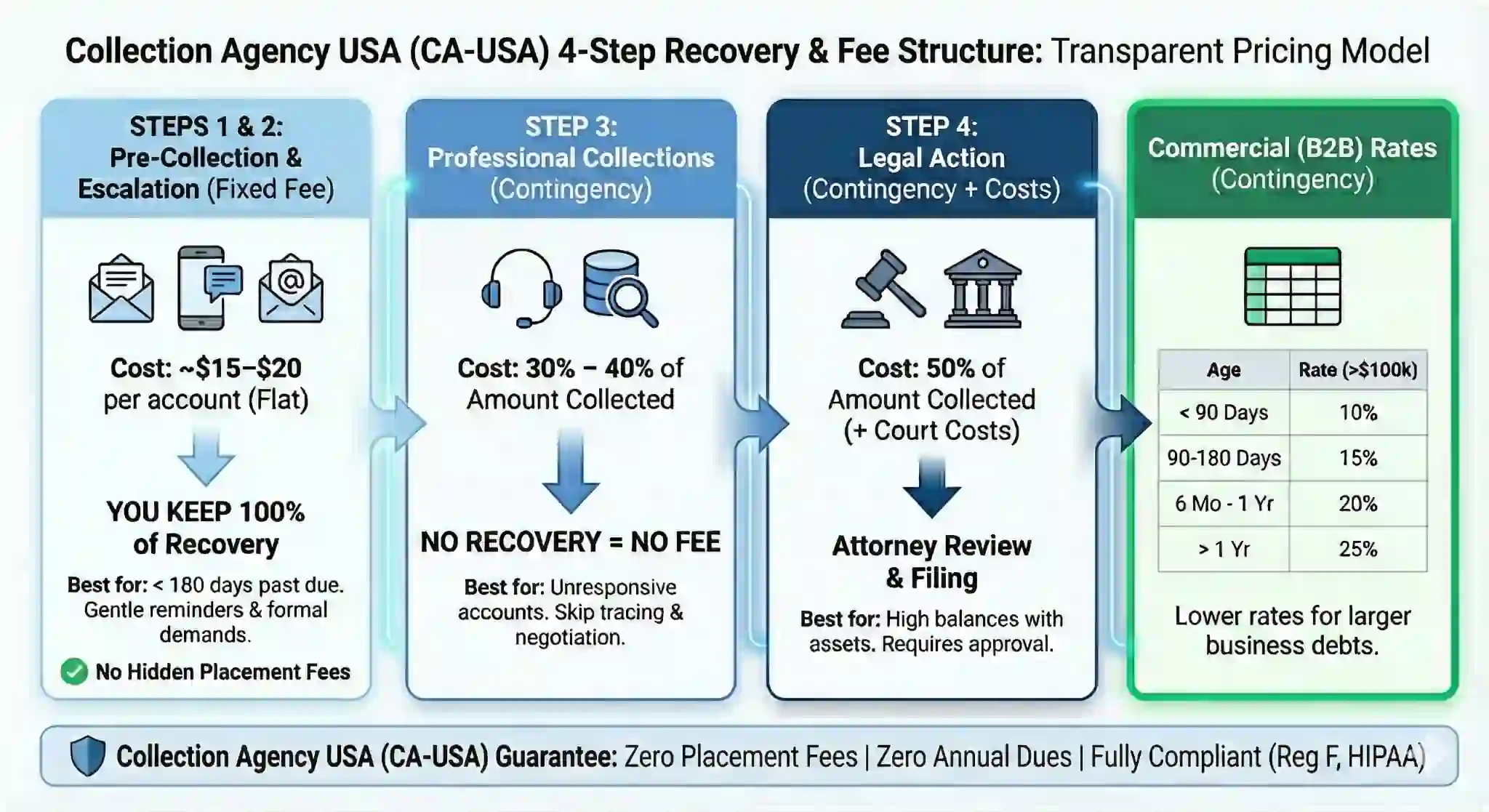
After two billing cycles of non-payment, pursuing customers for overdue overdraft fees becomes cost-inefficient for banks. It is much more economical and less stressful to employ a collection agency to issue five initial reminders as the first-party, followed by five third-party legal demands to your customer over a 90-day period. This fixed-fee service of 10 contacts is priced at approximately $18 per account, which breaks down to less than $2 per communication attempt. Accounts that remain unpaid can  be further sent for traditional collections where a debt collector makes multiple calls to recover the fee.

Need a Collection Agency: Contact us

Serving banks and credit unions nationwide

Despite these adjustments, U.S. banks collected $7.7 billion in overdraft/NSF fees in 2022, a significant decrease from the peak of $11.97 billion reported in 2019.  The imposition of overdue overdraft fees, while financially beneficial for banks in the short term, can lead to several disadvantages in the long run.

  • One significant drawback is the potential damage to customer relationships. High fees or aggressive collection practices can lead to dissatisfaction, eroding trust and loyalty, which are crucial for customer retention. This dissatisfaction may prompt customers to switch to competitors, resulting in a loss of business.
  • Moreover, excessive reliance on fees for revenue can attract regulatory scrutiny, as authorities seek to protect consumers from unfair banking practices. Such scrutiny can lead to regulatory actions, fines, or mandates to change practices, impacting the bank’s operations and reputation.
  • Additionally, the administrative burden of managing and collecting overdue fees can be substantial, diverting resources from more productive activities.

Collection agencies offer a variety of products and services designed to assist banks and other financial institutions in recovering overdue debts, such as overdraft fees.

1. Debt Collection Services

  • Direct Collection: Traditional debt collection efforts involving phone calls, letters, and emails to debtors to negotiate repayment of overdue overdraft fees.
  • Legal Collection: For accounts that are significantly overdue and unresponsive to standard collection efforts, some agencies offer legal services to pursue debt recovery through the court system.

2. Skip Tracing

  • Agencies use advanced databases and search techniques to locate debtors who have moved or are otherwise difficult to contact, ensuring that efforts to recover the overdraft fees can continue.

3. Credit Reporting

  • Collection agencies can report unpaid debts to credit bureaus, which can motivate debtors to settle their debts to avoid negatively impacting their credit scores.

These services are tailored to navigate the complexities of debt recovery while maintaining compliance with legal standards and preserving customer relationships.

Filed Under: debt recovery

by

Ensuring Your Online Contract is Legally Binding

Is your online contract legally binding?

Online service providers face unique challenges in ensuring they have the legal right to recover money if their bills are not paid. Proper documentation and clear terms of service are critical in these situations. Here’s how online service providers can prepare and what kind of documentation they should have in place:

  1. Service Agreement/Contract: This is the foundational document that outlines the nature of the services provided, payment terms, and obligations of both parties. It should be detailed and clear, specifying the amount to be paid, payment deadlines, and any penalties for late payments. The agreement should be accepted by the customer, ideally through a clickwrap agreement (where users click to agree) or sign-in process that requires agreement before services are provided.
  2. Utilizing Electronic Signature Services for Authenticity: Companies like RightSignature and Docusign offer electronic signature services that are instrumental in proving the authenticity of agreements and contracts. These platforms provide a secure and legally recognized way to obtain signatures on service agreements, contracts, and terms of service documents electronically. The use of such services adds a layer of verification and non-repudiation, as they often include time stamps, IP address logging, and email confirmation to track who signed the document and when. This can be particularly useful in legal disputes or collection efforts, as it provides irrefutable evidence that the customer agreed to the terms, including payment obligations. RightSignature and similar platforms ensure that electronic agreements are as legally binding as their paper counterparts, adhering to laws such as the U.S. Electronic Signatures in Global and National Commerce Act (ESIGN) and the Uniform Electronic Transactions Act (UETA), among others globally. Incorporating electronic signature technology into the contract and agreement process not only streamlines operations but also strengthens the legal enforceability of online transactions. Email a copy of this digital contract to their email address.
  3. Tele-Verification of the Client: Implementing tele-verification as part of the client onboarding process can significantly enhance the authenticity and reliability of the client information. This involves contacting the client via telephone to verify the details provided during the signup or agreement acceptance phase, such as their name, contact information, and payment details. Record this conversation with their consent. Tele-verification serves multiple purposes: it confirms the client’s identity, ensures that the contact information is accurate and operational, and provides an additional layer of consent for the services and payment terms. For instance, during the call, the service provider can reiterate key terms of the agreement, confirm the client’s understanding and acceptance, and answer any immediate questions. This process not only strengthens the legal standing of the agreement by adding a verbal confirmation but also enhances customer service and establishes a direct line of communication with the client. Documenting the outcome of the tele-verification call, including the date, time, and summary of the conversation, further solidifies the contractual agreement and can be invaluable in case of disputes or collection efforts.
  4. Terms of Service/Use: The Terms of Service (ToS) or Terms of Use document should outline the legal terms and conditions that the user agrees to for using the service. It should include payment terms, the consequences of non-payment (such as service termination or collection actions), and data use policies. It’s crucial that users explicitly agree to these terms, often achieved through a checkbox or acceptance button during signup or checkout processes.
  5. Invoices and Payment Records: Keeping accurate and detailed records of invoices and payments is essential. Invoices should include service dates, amounts due, payment deadlines, and a clear description of the services provided. Payment records should document any payments received, including the date, amount, and method of payment. In the case of a dispute or collection effort, these records serve as evidence of the debt owed.
  6. Communication Records: Document all communications with the customer regarding the account, especially those related to billing inquiries, payment reminders, notices of overdue payments, and any agreed-upon payment plans or resolutions. This can include emails, letters, and even logs of phone conversations. These records can demonstrate attempts to resolve the issue amicably and the customer’s awareness of the debt.
  7. Proof of Service Delivery: Depending on the nature of the online service, providers should maintain records that prove the customer received and used the service. This could be logs of user activity, delivery confirmations for digital products, or acknowledgments of service received. This documentation is crucial to counter any claims that the services were not rendered as agreed.
  8. Privacy Policy and Data Use Agreements: While not directly related to payment recovery, having a clear privacy policy and any necessary data use agreements in place is essential for legal compliance. These documents should detail how customer data is collected, used, and protected, and comply with regulations like GDPR or CCPA where applicable. Violations can lead to legal issues that complicate collection efforts.
  9. Dispute Resolution and Governing Law Clauses: Including clauses in your contracts or terms of service that specify how disputes will be resolved (e.g., arbitration, mediation) and under what jurisdiction’s laws the contract is governed can streamline resolving any disputes that arise, including non-payment issues.

By preparing these documents and ensuring they are correctly executed and maintained, online service providers can establish a clear legal basis for the recovery of unpaid bills. It’s also advisable to consult with a legal professional specializing in online commerce to ensure all documents and procedures comply with applicable laws and regulations, offering the best protection in case of non-payment.

Filed Under: debt recovery

  • « Go to Previous Page
  • Page 1
  • Interim pages omitted …
  • Page 3
  • Page 4
  • Page 5
  • Page 6
  • Go to Next Page »

Primary Sidebar

blank

Unpaid Bills? Contact Us

    Please prove you are human by selecting the cup.


    Email : support@CollectionAgencyUsa.com
    Ph: 1-844-666-7890

    Recent Posts

    • Ohio Dental Collections: Clinical, Compliant, and Community-Focused
    • Florida Dental Collections That Stay Clinical – Not Combative
    • Texas Dental Balances Don’t Age Gracefully, Recover Them Clinically
    • Close More Deals: Sales Enablement for Collection Agencies
    • 10-Step Checklist for California Dentists Before Hiring a Collection Agency
    • Trusted New York Debt Collection Services: Fully Compliant Nationwide
    • Need a Collection Agency in Pennsylvania?
    • Better than a Bot: Boost Debt Recovery with AI Collections
    • Maximize Recovery, Minimize Costs with Fixed-Fee Demands
    • 6 Smart Checks to Spot a Good Collection Agency Quickly

    Featured Posts

    • 10-Step Checklist for California Dentists Before Hiring a Collection Agency
    • Things a Medical Collection Agency Can’t Do During the Recovery Process
    • Types of Medical Debts that Cannot be Reported
    • Ohio Dental Collections: Clinical, Compliant, and Community-Focused

    COPYRIGHT: SACHING.COM | 2024 | ALL INFORMATION ON THIS WEBSITE IS FOR GENERAL INFORMATION ONLY AND IS NOT AN EXPERTS ADVICE. VISIT OUR HOME PAGE TO KNOW MORE ABOUT US.