The landscape governing medical credit reporting has undergone dramatic shifts, creating significant compliance challenges for healthcare providers, billing departments, and revenue cycle management (RCM) teams. Relying on outdated credit bureau reporting strategies for delinquent patient accounts exposes healthcare practices to legal liabilities, state-level regulatory enforcement, and reputational damage.
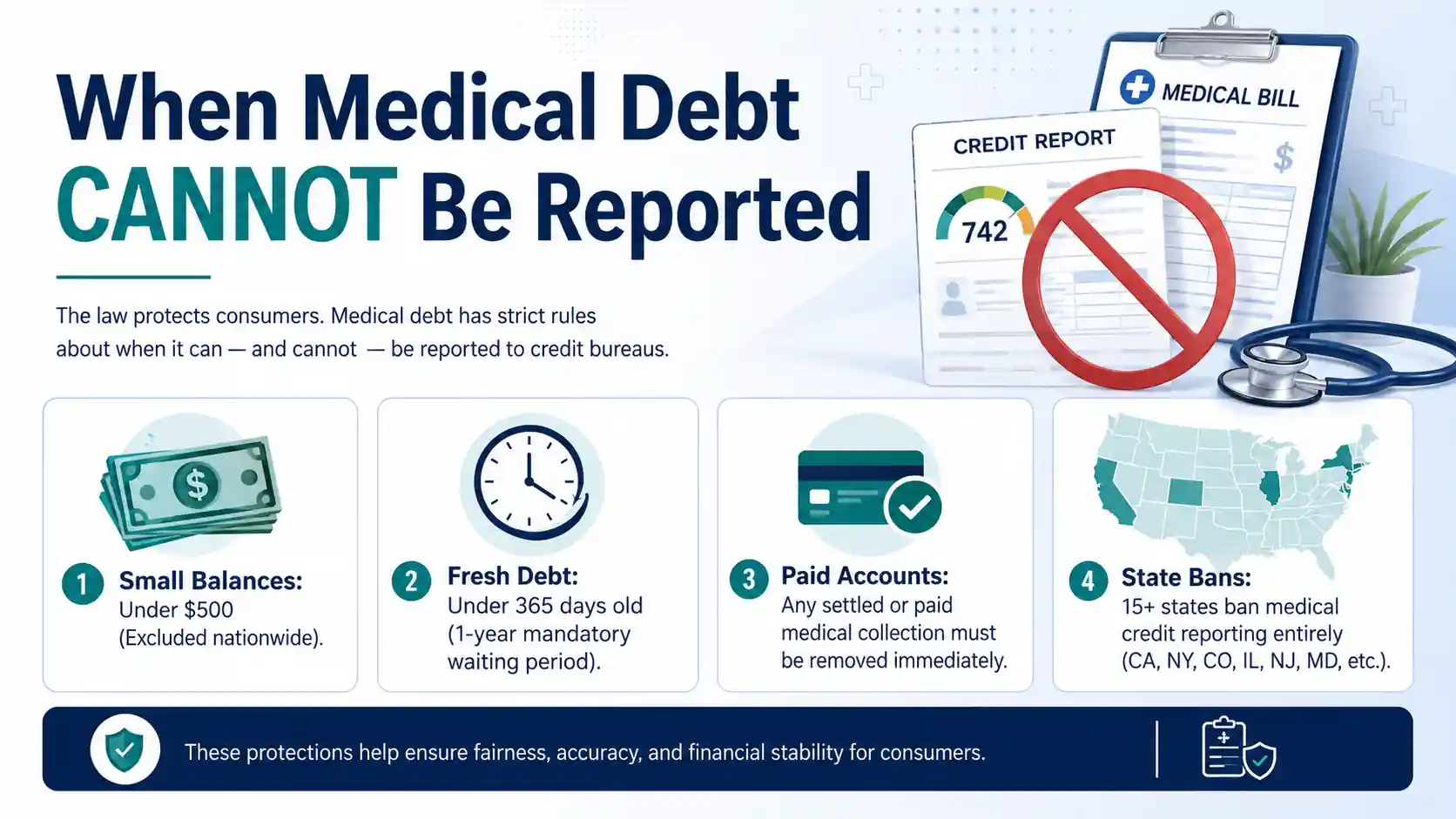
To maintain cash flow while remaining fully compliant, hospitals, private practices, and medical billing entities must navigate a complex regulatory matrix comprising nationwide credit bureau policies, state-specific reporting bans, and strict federal healthcare privacy rules.
⭐️ Trusted Partner in Compliant Healthcare Revenue Recovery
Backed by a 4.8-star Google rating across 2,000+ verified client reviews, nationwide 50-state licensing, SOC 2 Type II data security, and strict HIPAA/FDCPA compliance, CA-USA provides diplomatic, early-out patient recovery and compliant healthcare debt collection across all 50 states.
Quick Answer: Can Healthcare Providers Report Medical Debt to Credit Bureaus?
Yes, but under severe restrictions. While a federal CFPB rule banning medical credit reporting was struck down in court, the three major credit bureaus (Equifax, Experian, TransUnion) voluntarily exclude all paid medical debt, medical debts under $500, and unpaid medical debts under 1 year old. In addition, at least 15 states prohibit or substantially restrict medical debt from appearing on consumer credit reports. The precise scope, covered entities, exceptions, and effective dates vary by state.
Need a Medical Collection Agency: Contact Us
The 3-Layer Regulatory Matrix for Medical Credit Reporting
Evaluating whether a delinquent patient balance can be reported to credit bureaus requires auditing the debt against three distinct legal and regulatory layers:
1
Major Credit Bureau Policies (Equifax, Experian, TU)
- No paid medical debt: Automatically removed upon payment.
- No balances under $500: Permanently excluded nationwide.
- 365-day waiting period: Required for debts over $500.
2
State-Level Medical Reporting Bans
- Over 15 states prohibit medical debt reporting completely.
- Includes CA, NY, CO, IL, NJ, MD, MN, NV, CT, and others.
3
Federal Privacy & Patient Protections
- HIPAA BAA Required: Signed Business Associate Agreement mandatory.
- FCRA Standards: Strict data accuracy and dispute resolution rules.
Credit Bureau Reporting Rules at a Glance
| Medical Debt Category | Reportable to Credit Bureaus? | Mandatory Waiting Period & Compliance Conditions |
| Paid Medical Collections | ❌ Prohibited | Automatically removed by all 3 major bureaus immediately upon payment or settlement. |
| Unpaid Medical Debt Under $500 | ❌ Prohibited | Completely excluded from consumer credit files nationwide regardless of delinquency length. |
| Unpaid Medical Debt Over $500 | ⚠️ Conditional | Must wait 365 days from original delinquency date before reporting; subject to state law. |
| Debts in Ban States (CA, NY, CO, IL, etc.) | ❌ Prohibited | State legislation strictly prohibits reporting medical debt to CRAs regardless of balance size. |
Key Compliance Requirements for Healthcare Providers
1. The 365-Day Grace Period
Healthcare providers and collection agencies cannot report an unpaid medical debt over $500 until at least 365 days have passed from the initial date of delinquency. This buffer allows insurance claims, secondary coverage disputes, financial assistance applications, and appeals to be resolved before consumer credit scores are impacted.
2. State-Level Medical Debt Bans
A growing number of states—including California, New York, Colorado, Illinois, New Jersey, Maryland, Minnesota, Nevada, and Connecticut—have enacted state legislation banning medical debt reporting entirely. Healthcare systems operating in or treating residents from these jurisdictions must disable credit bureau reporting workflows for those patient files.
3. HIPAA Privacy & BAA Execution
Transmitting patient billing information to a collection agency or reporting engine requires a signed Business Associate Agreement (BAA). Under HIPAA’s Minimum Necessary Standard, only essential financial data (patient name, contact details, balance amount, and dates of service) may be shared—never clinical diagnoses, treatment codes, or medical history.
Modern Healthcare RCM: Moving Beyond Credit Reporting
Because credit reporting is no longer a viable recovery lever for small balances or early-stage delinquent accounts, forward-thinking medical practices focus on early-out patient engagement:
-
Upfront Financial Counseling & Eligibility Screening: Identifying uninsured or underinsured patients early to evaluate presumptive charity care or Medicaid eligibility.
-
Transparent Cost Estimates (No Surprises Act): Delivering clear pre-service estimates to minimize post-care billing disputes.
-
Flexible Interest-Free Payment Plans: Offering structured monthly installment options within the first 90 days of discharge.
-
Compassionate Early-Out Collection Outreach: Deploying soft, diplomatic written and digital communication options that preserve the patient-provider relationship.
Why Healthcare Systems Partner with CA-USA
-
HIPAA & SOC 2 Type II Certified Security: Enterprise-level encryption and security standards protecting Protected Health Information (PHI) and patient records.
-
Automated State & Balance Filtering: Our proprietary workflows automatically scrub patient accounts against state credit reporting bans and the $500 balance threshold before any outreach occurs.
-
4.8-Star Rated Patient Communication: Respectful, empathetic mediation that resolves outstanding accounts without generating patient complaints or negative online reviews.
-
Seamless EHR/EMR Integration: Direct compatibility with Epic, Cerner, AthenaHealth, eClinicalWorks, and major healthcare billing software platforms.
Frequently Asked Questions
Can medical debt under $500 be reported on a credit report?
No. Equifax, Experian, and TransUnion permanently removed all medical collection accounts under $500 from consumer credit reports nationwide.
How long must a hospital wait before reporting unpaid medical debt?
Healthcare providers and collection agencies must wait at least 365 days (1 year) from the initial delinquency date before an unpaid medical bill over $500 can legally appear on a credit report.
What happens to a medical collection on a credit report once it is paid?
Once a medical collection balance is paid in full or settled, credit reporting agencies are required to remove the entry entirely from the consumer’s credit history rather than listing it as “paid collection.“
Are healthcare collection agencies required to sign a HIPAA BAA?
Yes. Any third-party collection agency or billing service handling patient accounts must execute a formal Business Associate Agreement (BAA) to ensure full HIPAA privacy compliance.
Detailed – Medical Credit Reporting Restrictions by State
Current high-level summary as of August 3, 2026
This is just for general reference. Rules keep changing, therefore kindly double check rules before using any information mentioned here.
Nationwide baseline
In every state, the three nationwide credit bureaus generally exclude:
- Paid medical collections.
- Medical collections with an initial reported balance below $500.
- Unpaid medical collections that are less than one year old.
These are credit-bureau policies rather than a complete federal statutory ban. The CFPB’s broader federal medical-debt rule was vacated by a federal court in July 2025.
States with additional restrictions
| State | State-specific medical credit-reporting restriction |
|---|---|
| California | Consumer reporting agencies may not include medical debt in consumer reports. Health care providers, collectors and their agents generally cannot furnish it. General-purpose credit-card debt is not necessarily protected. Effective January 1, 2025. |
| Colorado | Medical debt generally cannot appear on consumer reports or affect credit scores. An exception may apply to credit transactions exceeding the applicable FHFA conforming-loan limit. |
| Connecticut | Health care providers and collection entities doing business in Connecticut may not report any portion of medical debt to a credit-rating agency. Effective July 1, 2024. |
| Delaware | No person may furnish medical debt to a consumer reporting agency, and a reporting agency may not issue a report containing medical debt it knows or should know about. Effective October 27, 2025. |
| Illinois | Consumer reporting agencies may not maintain or furnish adverse medical-debt information. Medical providers and their collection agents are also restricted from reporting it. Effective January 1, 2025. |
| Maine | Consumer reporting agencies are prohibited from reporting medical debt under the state’s expanded 2025 law. Maine previously provided additional protection during payment plans and waiting periods. |
| Maryland | Consumer reporting agencies may not generate, maintain or distribute reports containing adverse medical-debt information. Health care providers, facilities and ambulance services may not furnish it. Effective October 1, 2025. |
| Minnesota | Health care providers, collectors and other collecting parties may not report medical debt that they know or should know was originally owed to a health care provider. Effective October 1, 2024. |
| New Jersey | Medical creditors and collectors generally may not furnish medical debt. Credit bureaus are expressly prohibited from reporting paid medical debt or medical debt below $500. The law contains exclusions for general-purpose credit cards, secured debt and certain other obligations. |
| New York | Credit agencies generally cannot collect or report medical debt furnished by New York-regulated providers, hospitals and ambulance services. Debt from an out-of-state provider or placed on a general-purpose credit card may fall outside the protection. |
| Oregon | Medical service providers may not furnish the existence or amount of medical debt, and consumer reporting agencies may not include debt they know or should know is medical. General-purpose credit-card debt is excluded from the definition. |
| Rhode Island | Health care providers and emergency ambulance services may not furnish medical debt, and credit reporting agencies may not acquire, record or report medical debt. |
| Vermont | Credit reporting agencies may not report or maintain medical debt in a consumer’s file. The law excludes veterinary debt, ordinary credit cards, home-equity or general-purpose credit lines, and secured debt. |
| Virginia | Medical providers and collection entities are restricted from furnishing medical debt for inclusion in consumer reports. Ordinary general-purpose credit-card debt is generally excluded from the statutory definition. |
| Washington | Medical debt may not be included in a consumer credit report. Furnishing prohibited medical debt can make the debt void and unenforceable under state law. |
| Nevada | Not a complete statewide ban. Medical debt generally cannot be reported during a required collection-notification period. Hospitals may also face reporting restrictions when they fail to comply with specified billing and price-transparency requirements. |
| Texas | Not a complete statewide ban. Hospitals face conditions before reporting certain medical debt, including requirements connected with estimates and billing disclosures. The nationwide bureau rules still provide the main protection for most accounts. |