Restoration contractors operate in one of the most high-risk financial environments in the B2B sector. When emergency water mitigation, fire restoration, mold remediation, or storm cleanup projects are completed, getting paid is rarely a simple matter of invoicing a customer. Instead, restoration businesses face a complex web of insurance adjuster short-pays, non-signed Direction to Pay (DTP) contracts, evolving Assignment of Benefits (AOB) state bans, mortgage company dual-party check holds, and state-level price-gouging scrutiny.
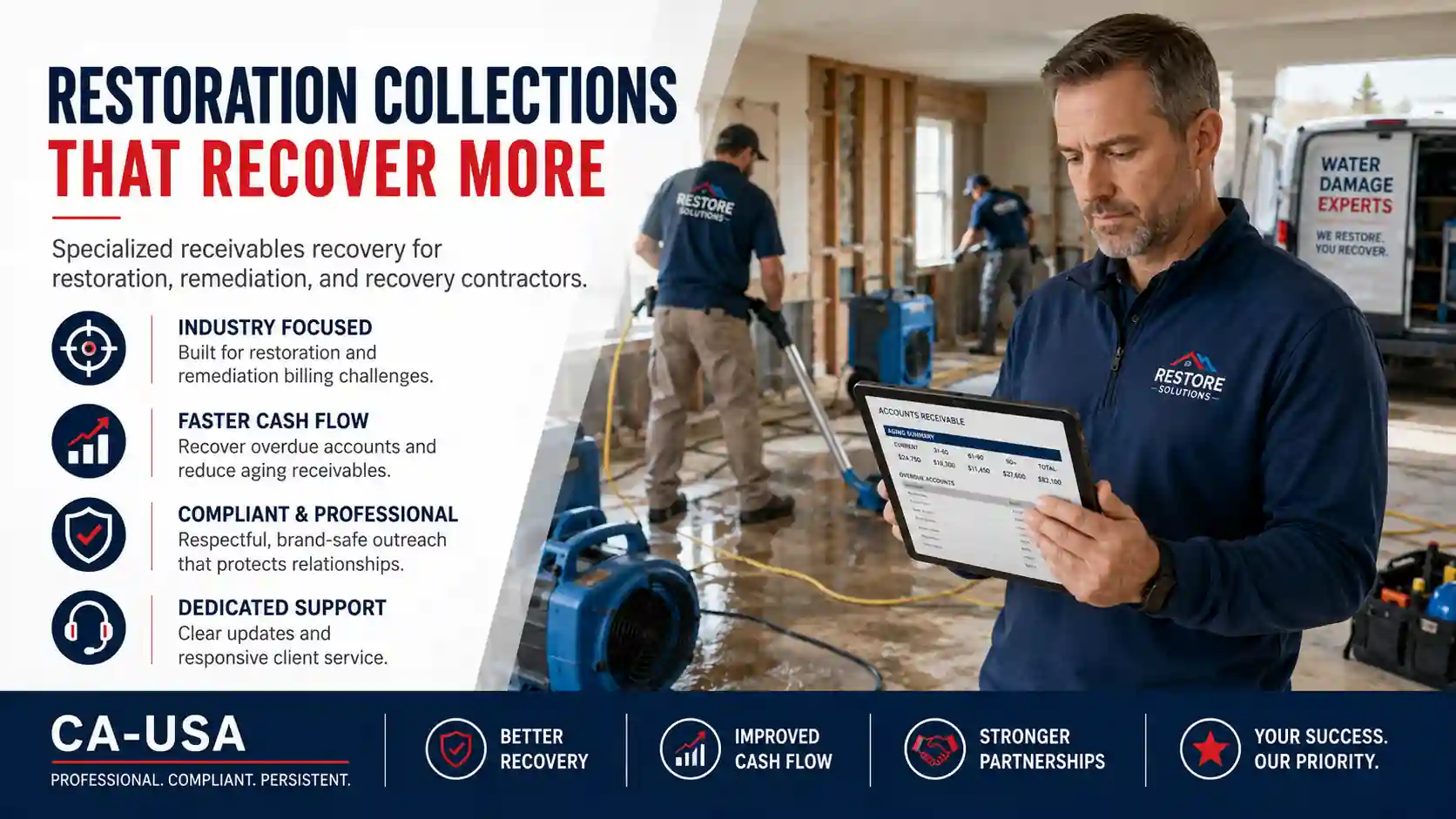
When insurance carriers underpay or property owners pocket insurance checks, traditional debt collection agencies fail because they don’t understand Xactimate pricing or IICRC standards. Successfully recovering restoration receivables requires a specialized agency that understands insurance claims, construction law, and post-disaster regulations.
⭐️ Trusted Leader in Restoration & Emergency Service Debt Recovery
Backed by a 4.8-star Google rating across 2,000+ verified client reviews, nationwide 50-state licensing, SOC 2 Type II data security, and strict FDCPA/FCRA compliance, CA-USA provides risk-free, diplomatic B2B debt collection, insurance short-pay mediation, and restoration judgment enforcement across all 50 states.
Quick Answer: How Does Restoration Debt Collection Work?
Restoration debt collection recovers unpaid invoices from water, fire, mold, and biohazard projects by navigating the tripartite relationship between Contractor, Policyholder, and Insurance Carrier. Recovery relies on enforcing Direction to Pay (DTP) agreements, evaluating state-specific Assignment of Benefits (AOB) rights, auditing Xactimate line-item short-pays, resolving mortgage escrow holds, and securing debt prior to the expiration of Mechanics’ Lien windows.
Serving hundreds of restoration companies nationwide: Contact us |
The Restoration Dispute Recovery Matrix
Resolving delinquent restoration accounts requires identifying the root cause of non-payment and applying the correct legal and operational recovery lever:
| Restoration Dispute Category | Liable Parties | Primary Root Cause | Specialized Agency Recovery Mechanism |
| Homeowner Check Retention | Property Owner / Insured | Customer receives single/dual-party insurance check and pockets the funds. | Diplomatic consumer demand, breach of DTP/AOB enforcement, Mechanics’ Lien Notice of Intent. |
| Insurance Adjuster Short-Pay | Insurance Carrier | Carrier arbitrarily reduces Xactimate equipment days, labor rates, or line items. | Technical audit using IICRC S500/S520 logs, carrier escalation, appraisal clause mediation. |
| Mortgage Escrow Hold | Mortgage Servicer / Lender | Dual-party insurance claim check ($10k+) stuck in mortgage lender escrow holding. | Direct lender mediation, progress inspection submittal, conditional lien release execution. |
| AOB State Ban / Policy Limit | Policyholder / Insured | Claim exceeds policy cap or state law restricts direct carrier action (e.g., FL AOB laws). | Soft consumer outreach, deductible collection, structured interest-free payment plans. |
4 Crucial Legal & Operational Realities in Restoration Debt Collection
1. Assignment of Benefits (AOB) vs. Direction to Pay (DTP)
An Assignment of Benefits (AOB) transfers the policyholder’s insurance post-loss rights to the contractor, allowing the restorer to bill and sue the insurance carrier directly for breach of contract. However, state laws regarding AOBs have shifted dramatically (e.g., Florida’s F.S. 627.7152 severely restricts AOB usage).
Where AOBs are restricted, contractors must rely on a strong Direction to Pay (DTP) clause combined with a direct customer contract. CA-USA evaluates your contract documentation to determine whether legal demand should be directed at the insurance carrier, the property owner, or both.
2. Mechanics’ Lien Rules for Pure Mitigation Work
Many restoration contractors assume a Mechanics’ Lien is always available if a job goes unpaid. However, courts in several jurisdictions (including Utah precedent) have ruled that pure emergency mitigation services—such as drying, extraction, dehumidification, and deodorizing—do not constitute a “permanent improvement” to real property and may be ineligible for mechanics’ liens.
Mechanics’ liens typically apply to the repair and reconstruction phase. Because of these legal distinctions and tight 60-to-90-day filing windows, relying solely on mechanics’ liens is risky—making early third-party debt collection essential.
3. Homeowner Check Retention (Two-Party & Single-Party Checks)
A common non-payment scenario in restoration occurs when the insurance carrier issues a claim check directly to the policyholder (or a dual-party check including the mortgage lender), and the policyholder deposits the funds without paying the restoration contractor.
When a homeowner pockets insurance funds intended for emergency repairs, it transitions from a simple contract dispute into conversion of funds and breach of contract. Our restoration team issues targeted legal demands that highlight the policyholder’s legal exposure for retaining insurance disbursements.
4. Post-Disaster Price-Gouging Compliance
During major storm events (hurricanes, freezes, floods), emergency mitigation invoices face intense scrutiny under state price-gouging statutes (e.g., Florida § 501.160, California Penal Code § 396). State Attorneys General actively prosecute contractors for excessive emergency markdowns—such as emergency tarping or equipment rate spikes during declared emergencies.
CA-USA screens incoming storm restoration files to ensure invoices align with localized Xactimate price lists and IICRC equipment logs before initiating collection outreach, protecting your business from regulatory traps.
Sub-Vertical Expertise: Water, Fire, Mold & Biohazard
Different restoration sub-verticals present unique collection challenges:
| Restoration Sub-Vertical | Technical Standards | Primary Collection Friction Points | Specialized Recovery Approach |
| Water Damage Mitigation | IICRC S500 Standards | Adjusters challenge equipment days (dehumidifiers/air movers) and psychrometric readings. | Audit daily moisture logs, chamber drying records, and challenge arbitrary line-item cuts with carriers. |
| Fire & Smoke Restoration | IICRC Structural Standards | High-dollar structural/contents cleaning disputes and mortgage lender escrow check holds. | Execute direct mortgage lender mediation and progress inspection verifications to release holds. |
| Mold Remediation | IICRC S520 Standards | Strict policy coverage caps (e.g., $5,000 limits) leaving customer out-of-pocket balances. | Verify pre-work scope sign-offs and structure flexible payment plans for non-covered balances. |
| Biohazard & Crime Scene | OSHA & Local Bio Standards | Highly sensitive, emotional, and traumatized policyholders or property owners. | Deploy compassionate, highly diplomatic communication protocols tailored to sensitive claims. |
4-Step Restoration Debt Recovery Protocol
When a restoration invoice hits 45–60 days past due or an adjuster issues a final short-pay denial, CA-USA executes a 4-step recovery process:
Step 1: Contract, AOB & Claim Audit
We review your signed authorization forms, Direction to Pay, Xactimate line items, moisture logs, and insurance carrier explanation of benefits (EOB) to identify all legally responsible parties.
Step 2: Insurance Carrier vs. Policyholder Outreach
If the carrier short-paid based on arbitrary line-item markdowns, we engage the carrier’s claims supervisor or legal department using IICRC standards. If the policyholder retained the insurance check, we initiate high-priority demand outreach.
Step 3: Mortgage Escrow & Lien Preservation
For checks stuck in lender holding, we work directly with mortgage servicing departments to deliver progress documentation and secure escrow release. Simultaneously, we monitor state Mechanics’ Lien notice windows to ensure property rights remain intact.
Step 4: Legal Escalation & Judgment Recovery
If voluntary mediation fails, our nationwide network of construction and insurance attorneys enforces recovery through civil litigation, insurance contract arbitration, or judicial judgment execution.
Why Restoration Contractors Partner with CA-USA
-
Restoration & Xactimate Expertise: Specialists trained in IICRC standards, insurance claim workflows, and carrier negotiation.
-
50-State Licensing & Bonding: Fully licensed, bonded, and compliant across every U.S. state and municipality.
-
SOC 2 Type II Certified Security: Enterprise-grade data protection securing sensitive policyholder records and claims documentation.
-
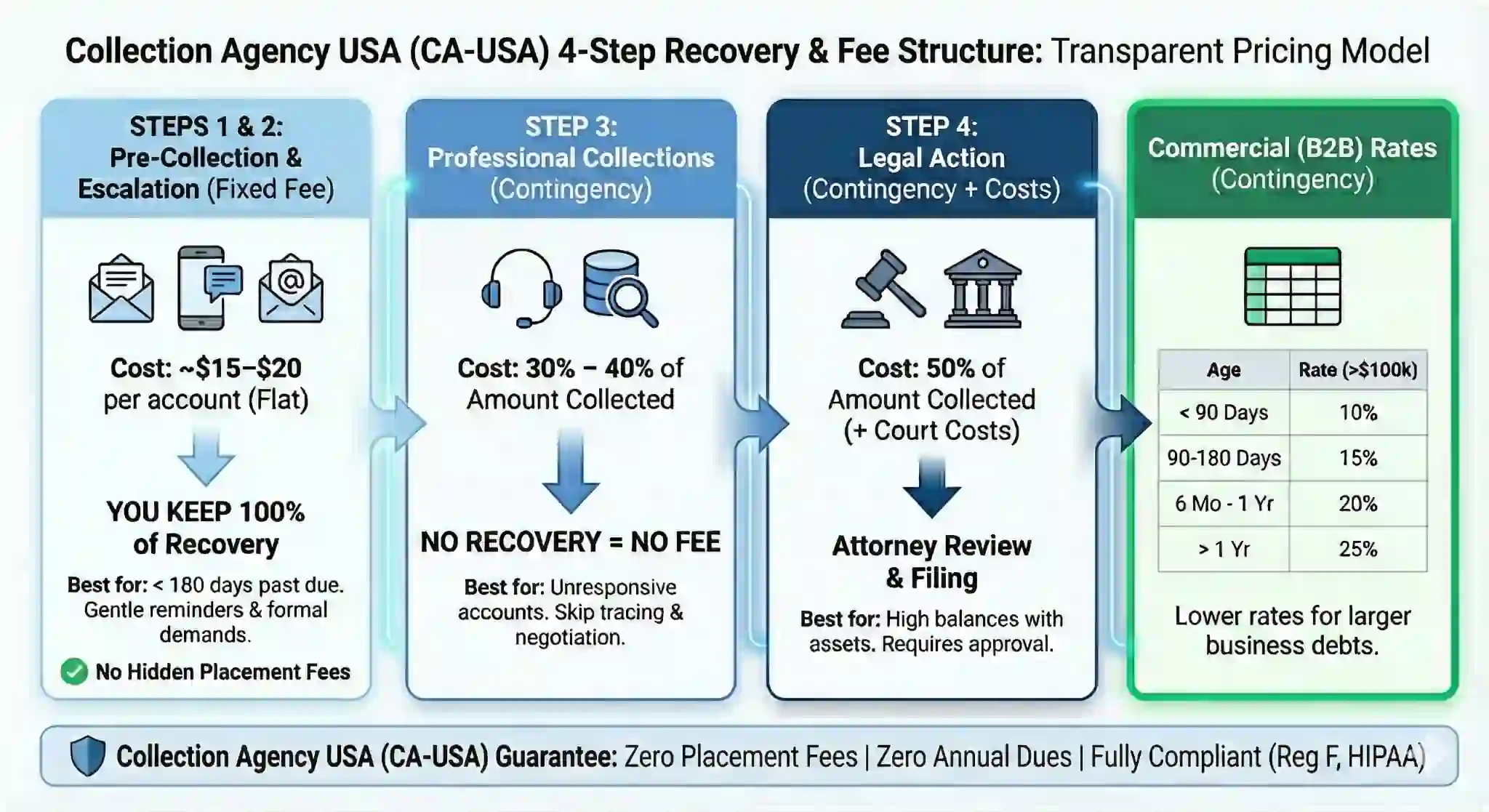
No Recovery, No Fee Guarantee: Contingency-based pricing means you pay nothing unless we successfully recover your funds.
Frequently Asked Questions
Can a collection agency recover insurance adjuster short-pays on Xactimate invoices?
Yes. Specialized restoration collection agencies review job logs, moisture readings, and IICRC standards to challenge arbitrary adjuster line-item markdowns directly with insurance claims departments.
What happens if a homeowner spends the insurance check meant for our restoration bill?
When a policyholder retains an insurance payout intended for restoration work, a specialized collection agency enforces the signed Direction to Pay (DTP) or AOB contract, pursuing civil recovery for conversion of funds and filing a Mechanics’ Lien notice if applicable.
Are emergency water drying and dehumidification services eligible for Mechanics’ Liens?
Not always. In several legal jurisdictions (including Utah court rulings), pure emergency mitigation—such as drying, extraction, and deodorizing—is classified as temporary service rather than a permanent property improvement, making it ineligible for a mechanics’ lien. This makes prompt third-party collection essential.
How do state price-gouging laws impact storm restoration collection?
States like Florida (§ 501.160) and California (Penal Code § 396) strictly enforce price-gouging caps during declared emergencies. Collection agencies must screen storm-related invoices against local Xactimate price lists and equipment logs to ensure compliance before initiating recovery.