A collection agency for small businesses helps recover overdue invoices while reducing the time owners spend chasing payments. Businesses can choose fixed-fee written demands costing $10–$27 per account or contingency collections with no upfront fee.
Do the math on your last unpaid invoice. Not the invoice amount, the hours: the follow-up emails, the “just checking in” calls, the mental tax of wondering if this is the one that finally pays. Add it up at whatever you actually bill per hour, and most small business owners are shocked at what “handling it myself” has actually been costing them. This isn’t a pitch for a big collections operation. It’s a fixed-fee option built for exactly the invoice you’re thinking about right now.

Three Myths Keeping Small Business Owners From Ever Making the Call
Myth: “It’ll cost more than the invoice is worth.”
Reality: A $10–$27 flat fee against even a modest invoice is rarely a bad trade, especially against the real cost of your own time. Bill yourself even $50 an hour for the calls and emails you’d otherwise be sending, and three hours of DIY follow-up already costs more than most fixed-fee accounts.
Myth: “A collection agency will be aggressive and I’ll lose the customer for good.”
Reality: The first move isn’t a threatening phone call, it’s five written demands sent under professional letterhead, enough on its own to resolve the account over 40% of the time. A customer who eventually pays in full often keeps buying from you afterward. A 4.85-star rating from 1,500+ business owners who’ve actually gone through this process is the real answer to whether “sent to collections” has to mean “relationship over”: for most of them, it didn’t.
Myth: “I only have one small unpaid invoice, it’s not worth the hassle of a whole ‘agency.'”
Reality: There’s no minimum, no annual commitment, and no reason a $400 invoice gets treated differently than a $40,000 one. The paperwork is the same either way. Waiting to “save up” a batch of bad debt before doing anything just gives the oldest accounts more time to become genuinely uncollectible.
The Real Math
| Path | What Actually Happens |
|---|---|
| Do nothing | ~$0 recovered; the invoice quietly gets written off |
| Chase it yourself | Real hours spent, no guarantee of payment, and the “am I being too pushy” anxiety the whole time |
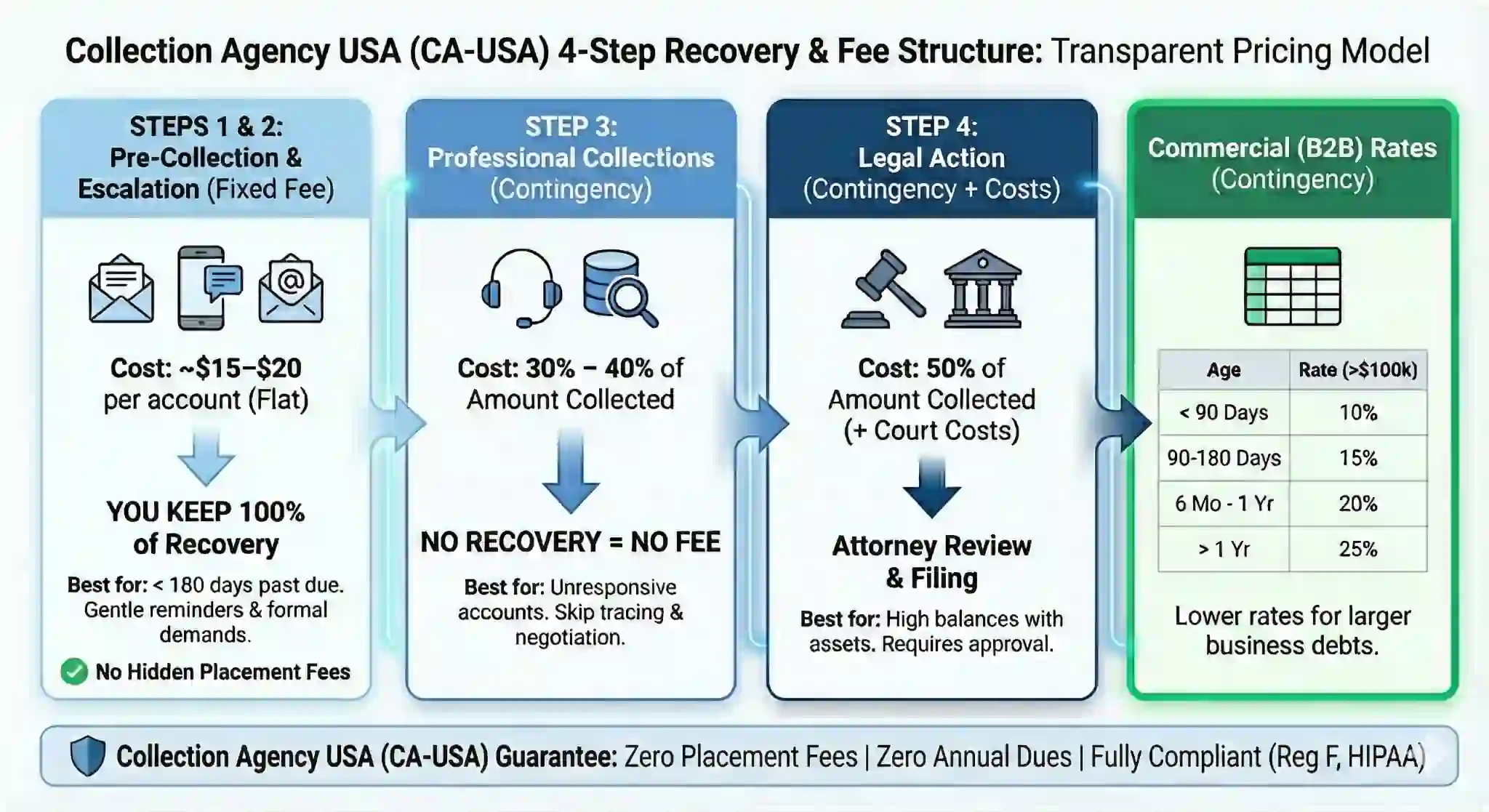
| Fixed-Fee (Option A) | $10–$27 flat per account, you keep 100% of whatever’s recovered, no calls required from you |
| Contingency (Option B) | $0 upfront, 40% of whatever’s recovered, built for accounts 120 days to 3 years old |
How It Actually Works
Option A: Fixed-Fee Collections – Written Legal Demands
Purchase a batch of accounts in advance and keep 100% of everything recovered. Five attorney-approved written demands go out under our name (one account = five contacts). Most effective for bills less than a year past due, and unused accounts never expire. Most clients can typically write this off as a business expense on their taxes after checking with their accountant. See why fixed-fee demands work for the fuller logic.
Option B: Contingency Collections – Collection Calls
No upfront fees. A professional debt collector makes multiple calls to your debtor, and we only earn if we collect, keeping 40% while you keep 60%. Built for accounts aged 120 days to 3 years, regardless of balance. Can be forwarded for legal collections with your approval.
Still deciding whether it’s even time to hand an account over at all? When to outsource debt collection covers that decision on its own.
What Happens After You Place an Account
The account gets verified first, then the five written demands go out under our name over the following weeks, giving the debtor several real chances to resolve it before anything more serious happens. If it doesn’t resolve, it either sits (Option A has no expiration) or moves to contingency calling (Option B), and if that stalls too, it can be forwarded to legal collections with your sign-off. Understanding debtor psychology explains why a professional third party often gets a response an owner’s own calls never did, and managing client relationships during debt recovery is worth reading if keeping the customer afterward matters to you, which for most small businesses, it does.
If your original agreement with this client was an online contract, it’s also worth confirming it’s actually legally binding before relying on it during collections.
We offer free credit reporting, free bankruptcy screening, and free skip tracing on every account, no joining fee, no minimums, no annual commitment. We also red-flag debtors with a history of suing businesses like yours. Everything runs through a secure online client portal.
Frequently Asked Questions
How do you identify “serial litigators” who sue small businesses when sent to collections?
Before initiating recovery, we run automated litigious debtor screening. If a debtor has a history of filing predatory lawsuits or TCPA/FDCPA counter-claims against small businesses, they’re red-flagged immediately. This protects your business from accidental legal liability before a single letter or call goes out.
Can fixed-fee collection costs actually be written off on my business taxes?
Yes, in most cases. Because our Option A fixed-fee service is purchased upfront as a professional debt collection expense, business owners can generally deduct the $10–$27 per account fee as a standard business operating expense. We always recommend confirming specific deductions with your CPA.
What happens if a non-paying client suddenly becomes a profitable repeat customer again?
Maintaining client relationships is critical for small business sustainability. By using our Fixed-Fee Written Demands (Option A) first, the outreach comes across as a firm administrative audit rather than an aggressive third-party demand. If the client pays 100% of the balance, you keep 100% of the money, allowing you to reset terms and preserve the long-term business relationship without burn-bridges tactics.
What if a debtor moves out of state or disappears entirely without leaving a forwarding address?
We perform free skip tracing on all accounts submitted. Using public records, utility listings, credit header databases, and proprietary lookup tools, we locate the debtor’s updated contact info and address at no extra charge to your business.
Why should a business choose $10–$27 fixed-fee demands over traditional contingency collections?
For debts less than 1 year past due, a formal third-party legal demand letter resolves the issue over 40% of the time. Choosing Option A (Fixed-Fee) lets you keep 100% of the recovered funds for a flat fee, whereas contingency collections (Option B) require giving up 40% of the recovered balance. Starting with fixed-fee demands saves thousands in commission fees.