Between evolving state laws and federal restrictions on traditional leverage, alongside rising K–12 meal debt and university tuition balances, outdated collection tactics create severe regulatory and PR risks for educational institutions.
Safely recovering unpaid tuition, meal balances, registration fees, and campus charges requires a diplomatic, privacy-first approach that protects your institution’s reputation while preserving sensitive parent, student, and alumni relationships.
A K-12 district and a university are both “schools” in casual conversation, but they face almost entirely different regulatory exposure when a balance goes unpaid. A public school district’s real risk is around meal debt: USDA policy requirements and a fast-growing list of state anti-“lunch shaming” laws. A college’s real risk is the transcript-withholding restrictions that took effect in July 2024. Treating both under one generic “school collections” playbook, the mistake most agencies (and most advice online) make, means missing the rules that actually govern whichever one you actually are. CA-USA (Collection Agency USA) builds the recovery strategy around the institution type first, not a one-size-fits-all script.
Quick answer: FERPA-compliant debt recovery differs by institution type: K-12 districts face USDA meal-debt rules and state anti-lunch-shaming laws, while colleges and universities face federal Title IV and state transcript-withholding restrictions effective since July 2024. Both require verifying authorized parties before disclosing any student financial record and avoiding tactics that single out the student rather than the responsible adult.
Ethical & Compliant Recovery for Private Schools, Colleges & Districts.
Contact us to recover student tuitions, meals and other fee !Backed by 4.8-star Google ratings across 2000+ reviews, our platform combines bank-grade data security, effortless ease of use, and dedicated customer support. |
Two Institutions, Two Different Rulebooks
K-12 Schools and Districts
The dominant issue here is meal debt, not transcripts. Every School Food Authority must maintain a written meal-charge policy under USDA rules, and more than a dozen states have banned “lunch-shaming” tactics outright: publicly identifying a student with debt, serving a different meal, or discarding a tray in front of classmates. Some states go further. California prohibits the use of a collection agency for student meal debt entirely, and Virginia bars school boards from suing a family over it. For private K-12 schools that charge tuition, a report card or diploma withheld over an unpaid balance is governed by ordinary contract law, not the college transcript-ban statutes below; the two get confused often, and shouldn’t be.
Colleges and Universities
Effective July 1, 2024, U.S. Department of Education rules significantly restrict withholding transcripts for any term covered by Title IV federal aid, the financial aid program that funds post-secondary education specifically. Beyond the federal layer, a dozen or so states, including New York, California, Colorado, Illinois, and Washington, ban transcript withholding as a collection tactic outright, regardless of aid status. An institution still relying on transcript holds as its main leverage is depending on a tool that’s disappeared, or is disappearing, jurisdiction by jurisdiction.
The 3 Hidden Legal & PR Risks of Generic Collection Agencies
Invalid Leverage (Colleges). An agency relying on transcript withholding as its primary threat for a college account is, in a growing number of states, threatening something it can no longer legally deliver.
The Front-Desk Nightmare (Both). When a generic agency’s tactics upset a parent or student, that complaint doesn’t go to the agency, it goes to the Bursar, the Principal, or a School Board member, turning a routine receivable into a governance headache.
FERPA Exposure (Both). Tuition and fee records are protected education records, not ordinary consumer debt. A collector who contacts a grandparent, stepparent, or employer to discuss a balance without verifying they’re an authorized party may be creating a federal privacy violation the institution is ultimately accountable for.
Standard Agencies vs. FERPA-Compliant Specialists
| Factor | Standard Collection Agency | FERPA-Compliant Specialist |
|---|---|---|
| K-12 meal debt | May apply the same tactics used for adult consumer debt | Follows USDA meal-charge policy and state anti-shaming rules specifically |
| College tuition debt | May still rely on transcript withholding as primary leverage | Credit reporting, skip-tracing, and negotiated plans, since transcript holds are restricted or banned in a growing number of states |
| FERPA awareness | Treats a balance like ordinary consumer debt | Verifies authorized parties before any disclosure, for both parents and college-age dependents |
| Escalation point | Complaints land on the Bursar’s or Principal’s desk | Diplomatic first contact designed to avoid escalation |
| Enrollment impact | Balance recovery only | Recovery structured to preserve re-enrollment where realistic (especially relevant for colleges) |
10 Core Expectations Institutions Demand From a Recovery Partner
- Compliance with Laws and Regulations — Strict adherence to the FDCPA, Regulation F’s call-frequency limits, and applicable education-sector and state-specific codes, whether K-12 or higher ed.
- Ethical Practices — Respectful, professional communication with families; no aggressive or harassing tactics, and no tactics that single out a student specifically.
- Transparency — Real-time reporting on accounts receivable so the Board or bursar’s office knows exactly where the budget stands.
- Efficiency and Effectiveness — Proven recovery strategies for tuition, technology fees, and meal debt that don’t drag on for months.
- Confidentiality and Security — FERPA, GLBA, and, where relevant, HIPAA-level protection of student and family financial data.
- Customized Services — Communication methods and timing tailored to whether the institution is a K-12 district or a college.
- Customer Service — Responsive to both the institution and the families being contacted, resolving disputes fairly.
- Minimal Disruption — The process runs largely independently, requiring minimal staff involvement.
- Affordable and Reasonable Fees — Costs that stay proportionate to what’s actually recovered.
- Positive Representation — Every interaction reflects on the institution, so the agency represents an educational institution, not a credit card company.
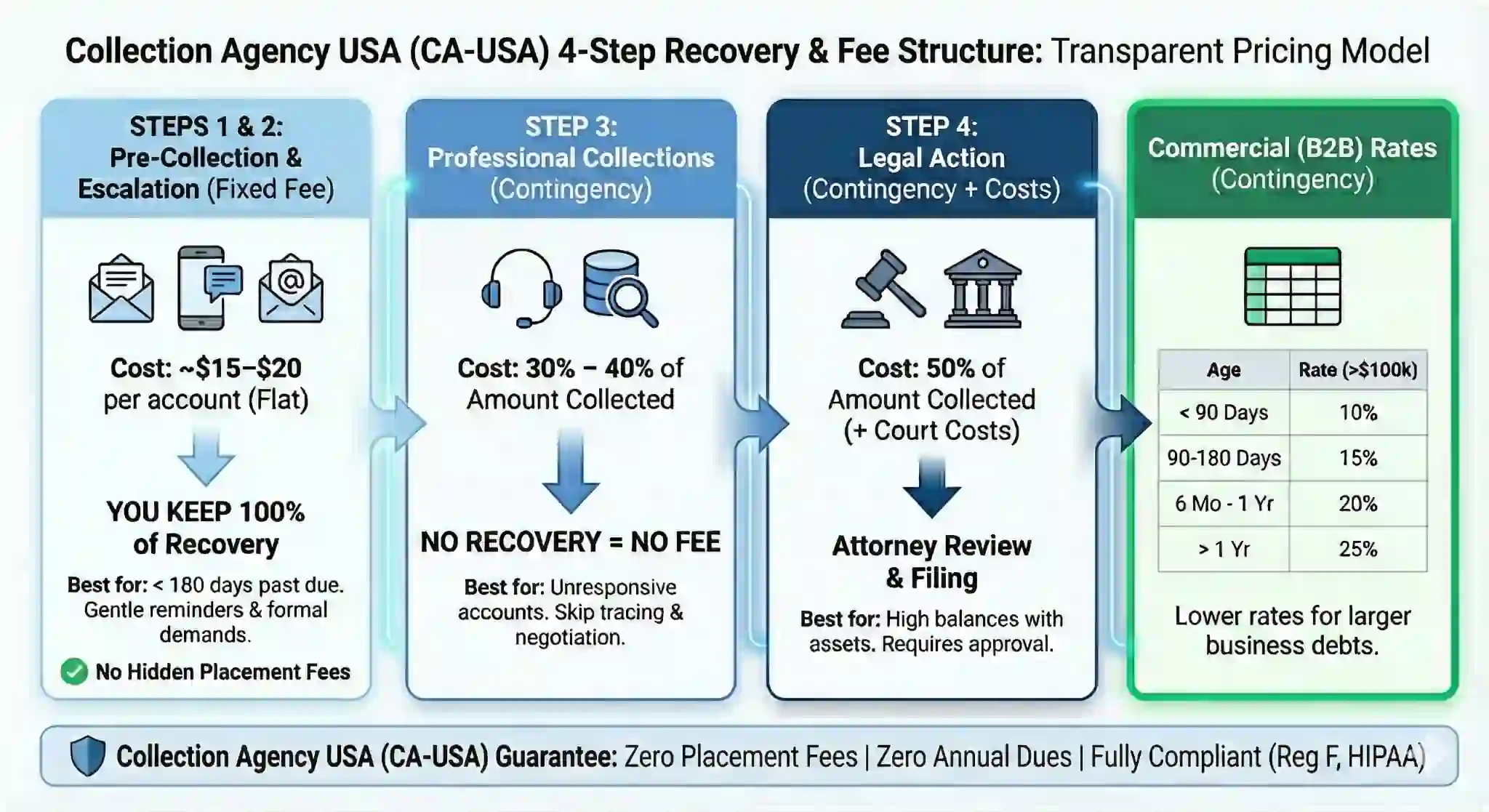
Cost Effective Collections
Choose between low cost fixed fee collections, or standard contingency collections.
Frequently Asked Questions
Does the federal transcript-withholding ban apply to K-12 private schools, or just colleges and universities?
It’s specifically a higher-education rule, tied to federal Title IV financial aid, which only funds post-secondary education. K-12 schools, public or private, don’t participate in Title IV and aren’t covered by this regulation. A private K-12 school withholding a report card or diploma over unpaid tuition is instead governed by ordinary contract law and whatever narrower state-specific rules exist, not the college transcript-ban framework. The two situations get confused constantly, and treating a K-12 tuition dispute as though the college-specific federal rule applies is a real, avoidable mistake.
How do you manage “Joint and Several Liability” when divorced parents dispute tuition bills?
The enrollment contract’s signatures decide liability, not a private custody arrangement between the parents. If both parents signed, the debt is generally treated as joint and several, meaning either party can be pursued for the full balance regardless of what a divorce decree says. Family court disputes between the parents are a separate matter from the institution’s contractual right to be paid.
How do new federal regulations impact transcript withholding for unpaid college balances?
As of July 1, 2024, transcript withholding for any term covered by Title IV federal aid is significantly restricted under U.S. Department of Education rules. Beyond the federal layer, several states, including New York, California, Colorado, Illinois, and Washington, have banned the practice outright regardless of aid status. This applies to colleges and universities specifically, not K-12 institutions.
Is collecting small “lunch debt” balances worth the public relations risk for a district?
Yes, when it’s done through low-cost, automated, non-punitive outreach rather than tactics that single out a child. The median district carries roughly $6,900 in unpaid meal debt, real money against a real budget, and polite digital reminders sent to a parent carry essentially none of the PR risk that hand-stamping or serving a different meal does.
How do you guarantee FERPA compliance during debt recovery outreach?
Compliance starts with verifying who’s actually authorized to discuss a specific student’s financial record before any conversation happens, not after a complaint. Tuition and fee balances are protected education records, so a call to an unverified party is a potential federal violation. Strict identity verification and data silos that prevent unauthorized disclosure are the baseline, not an add-on feature.
What is the difference between fixed-fee tuition demands and contingency collections for schools and colleges?
Fixed-fee demands are a flat, predictable cost for early-stage balances, generally the better fit for accounts still within the same or following term. Contingency collections carry no upfront cost but take a percentage of whatever’s recovered, better suited to older, charged-off, or unresponsive accounts. Most institutions use fixed-fee first and reserve contingency for what fixed-fee doesn’t resolve.
Contact us for a free consultation !
By CA-USA Editorial Team | Updated 2026